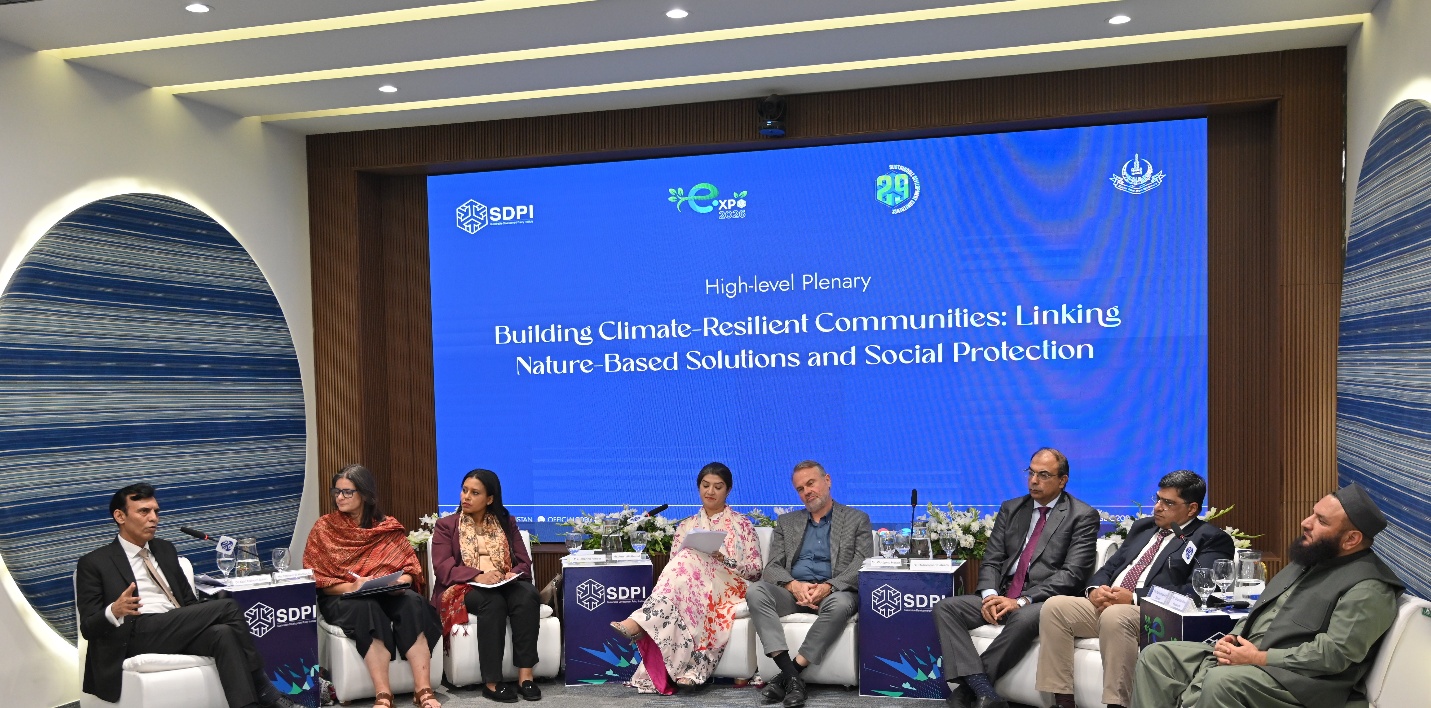
Building Climate-Resilient Communities: Linking Nature-Based Solutions and Social Protection Experts call for integrated climate resilience, social protection framework to protect vulnerable communities, Day 1, Plenary 1.5, 02 Nov
Plenary 1.5: Building Climate-Resilient Communities: Linking Nature-Based Solutions and Social Protection
Experts call for integrated climate resilience, social protection framework to protect vulnerable communities
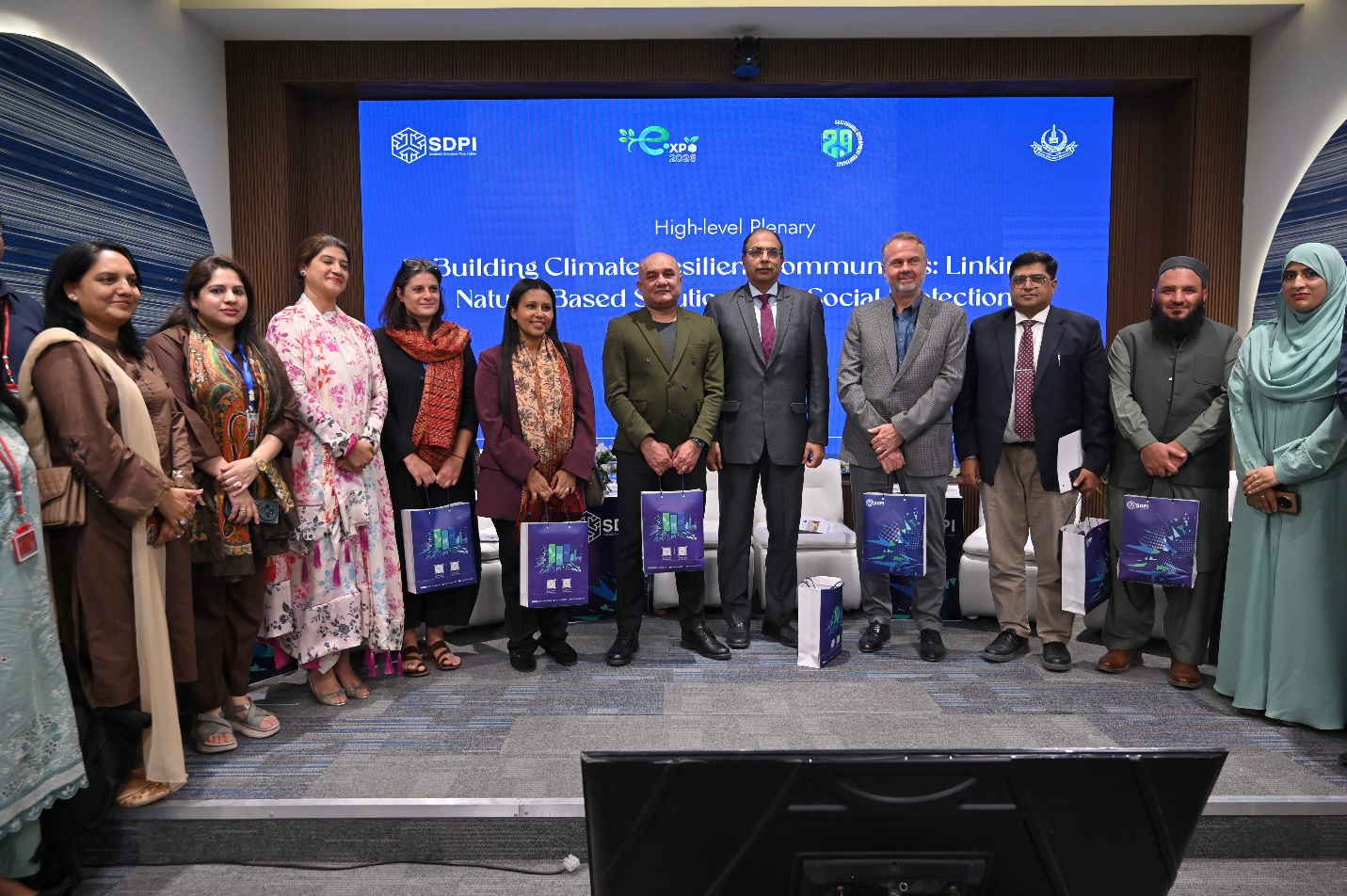
ISLAMABAD (02 November 2026): Pakistan needs an integrated approach linking climate risk assessments, disaster management, nature-based solutions, development planning and social protection to protect vulnerable communities from increasingly severe climate shocks, say experts and development practitioners.
This was the consensus developed at a high-level plenary, titled: ‘Building Climate-Resilient Communities: Linking Nature-Based Solutions and Social Protection’, organized by Sustainable Development Policy Institute (SDPI) in collaboration with Gesellschaft für Internationale Zusammenarbeit (GIZ) here at the Allama Iqbal Open University on Monday.
Johanna Knoess, Head of Adaptive Social Protection at GIZ Pakistan, said linking social protection databases with climate and disaster risk information was essential to ensure timely assistance to vulnerable communities. She said Pakistan had considerable data through institutions such as the Benazir Income Support Programme (BISP), the National Socio-Economic Registry, NADRA and the National Disaster Management Authority, but these databases had traditionally operated separately.
Ms Knoess said GIZ, with support from the German government and the European Union, was helping the government link BISP data with provincial databases and improve coordination between disaster management and social protection authorities.
She cited the launch of Pakistan's first-ever disaster risk policy in Khyber Pakhtunkhwa, under which social protection played a key role in enabling early action based on climate risk information.
Highlighting the exclusion of informal workers, particularly agricultural workers and women, from official databases, she said an initiative with the Sindh government had registered 600,000 households. She added that 800,000 women across Pakistan had received digital financial literacy training.
Abid Suleri, Executive Director of SDPI, said the National Disaster Risk Management Fund (NDRMF), established in 2016 with a $200 million Asian Development Bank loan, would focus on innovative solutions rather than conventional infrastructure projects.
He also highlighted NDRMF's National Catastrophe early-warning model, which identifies disaster-prone areas. Integrating its information into the Planning Commission's project approval process would help incorporate preventive measures into development schemes from the outset.
Arif Goheer, Executive Director of the Global Change Impact Studies Centre (GCISC), said fragmented data collection and the absence of an integrated framework linking climate projections, sectoral impacts and vulnerability assessments remained major obstacles to effective climate adaptation.
He said several agencies collected climate-related information, including baseline data, climate projections and casualty figures from floods and earthquakes, but the information was not interconnected, preventing policymakers from developing a comprehensive picture of climate risks.
Dr Mohamad Saleem, Director and Head of the SME, Housing and Sustainable Finance Department at the State Bank of Pakistan, said promoting a green and inclusive financial system was a key pillar of the central bank's five-year strategic plan.
He said the SBP introduced Green Banking Guidelines in 2017, with technical support from GIZ, requiring commercial banks to identify climate-related risks and develop policies to mitigate them. Banks were also advised to establish dedicated green banking departments, allocate resources and train staff.
Dr Asmat Nawaz, BISP Additional Secretary, said climate resilience and social protection were indispensable to improving the lives of marginalized communities. He said BISP data had played a key role in extending assistance whenever calamities struck, including during the 2022 floods, when the database supported initiatives such as house construction.
He said the introduction of social protection wallets and an interoperability mechanism would allow beneficiaries to withdraw their fixed cash assistance from any point-of-sale agent instead of being restricted to a designated agent. The change was intended to reduce beneficiaries' dependence on individual agents and eliminate opportunities for exploitation.
Meriem El Harouchi, Programme Manager for Migration, Forced Displacement and Resilience at the EU Delegation to Pakistan, said climate shocks quickly became economic and social liabilities, affecting poverty, livelihoods and inequality.
She said Pakistan's existing social protection programmes need to be connected with climate resilience and disaster management. Citing a 160-million-euro European Investment Bank package for rebuilding homes in Sindh and improving water quality in Karachi, she said better housing and safe water could reduce health risks and household expenses, helping families avoid falling into poverty.
Wolfgang Hesse, Cluster Coordinator for Energy, Climate Change and Just Transition at GIZ Pakistan, said the country contributed less than one per cent of global greenhouse gas emissions but remained among those hardest hit by climate change.
He said the 2022 floods affected 33 million people, claimed more than 1,730 lives and caused $14.9 billion in damage, while the 2025 floods affected 6.5 million people, claimed over 1,039 lives and caused $2.9 billion in damage.
Mr Hesse identified understanding risks, protecting natural resources and infrastructure, and directly supporting vulnerable families as essential components of climate resilience. He cited nature-based initiatives including a sponge city pilot in Multan, green roofs and rain gardens in schools in Charsadda and Peshawar, and agroforestry and climate-smart farming in Punjab.
Sanaullah Khan Hassanzai, Integrated Team Lead for Climate Risk Analysis at GIZ Pakistan, said climate risk assessments must go beyond hazard maps and incorporate satellite imagery, ground-level information and, most importantly, the lived experiences of communities.
Mr Hassanzai stressed that nature-based solutions should not be treated as an afterthought in infrastructure projects, such as simply planting trees alongside roads or irrigation channels. Instead, planners needed to consider wider environmental impacts, including developments upstream and their consequences downstream, as well as the benefits these interventions could deliver over decades.