Circular Economy Transition Beyond 2030: From Policy Ambition to Inclusive Action in South Asia, Day 3, 3.1, 04 Nov
Speakers call for mandatory EPR, source segregation & inclusion of informal workers in circular economy shift
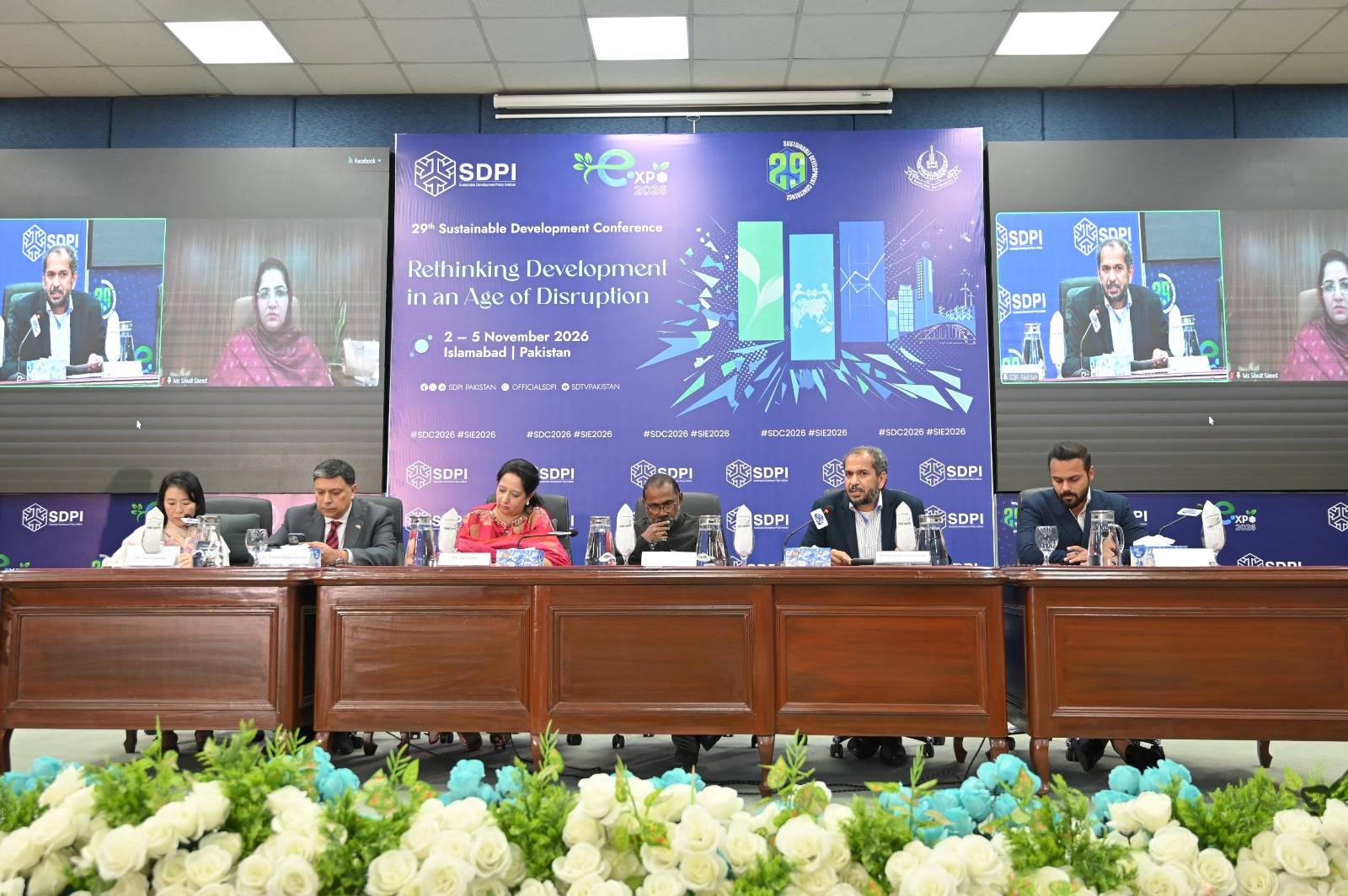
ISLAMABAD (04 November 2026): Government officials, industry representatives and development practitioners have said that Pakistan's move towards a circular economy will depend on source segregation, binding extended producer responsibility (EPR), reliable waste data and the inclusion of informal waste workers, stressing that policies must be implementable on the ground.
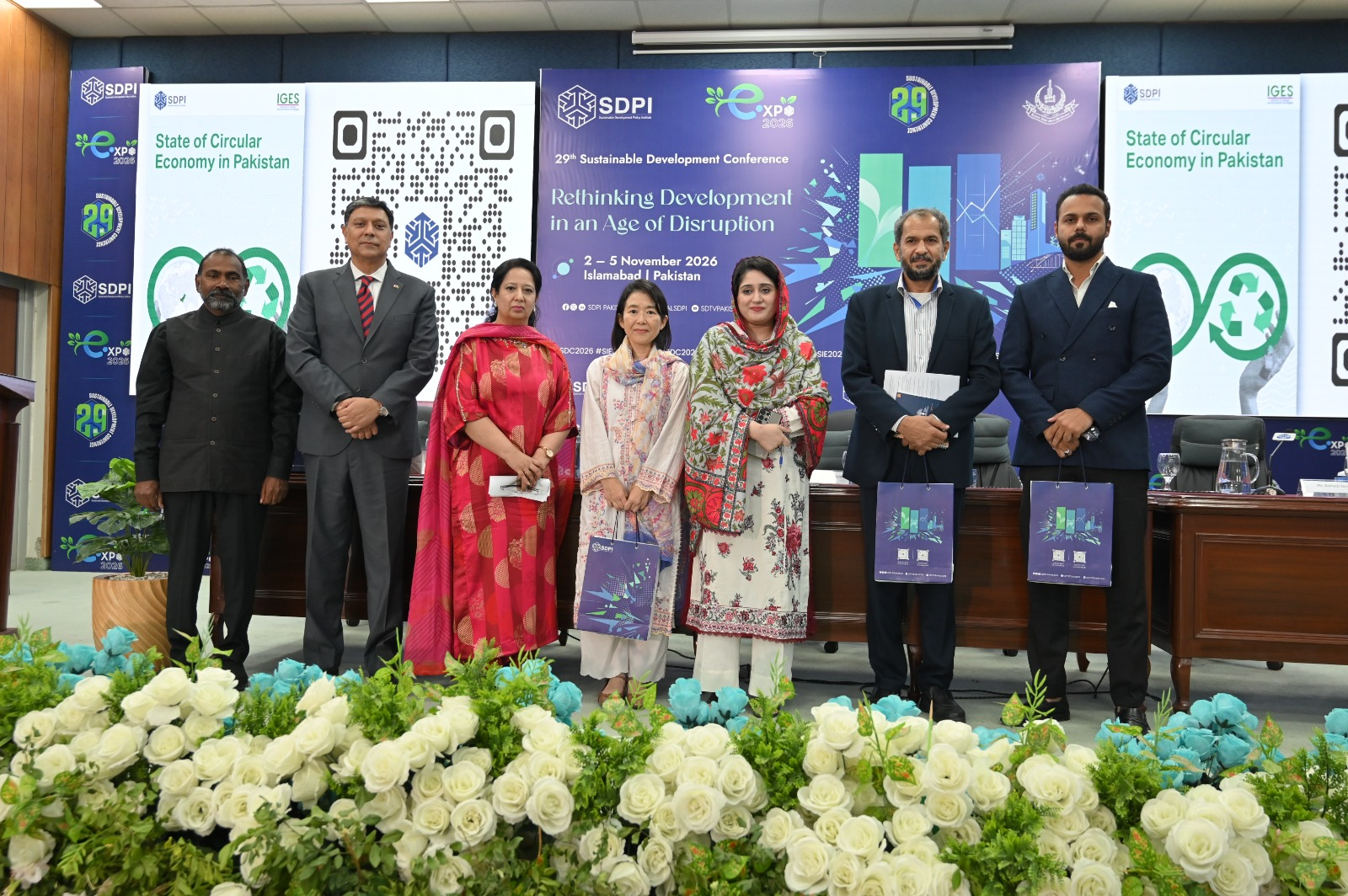
The consensus was made at a high-level plenary, titled: “Circular Economy Transition Beyond 2030: From Policy Ambition to Inclusive Action in South Asia”, organized on the third day of 29th Sustainable Development Conference by the Sustainable Development Policy Institute in collaboration with Institute for Global Environmental Strategies (IGES), Japan here on Wednesday. The overarching theme of this year’s conference is “Rethinking Development in an Age of Disruption”.
Speaking on the occasion, SDPI Executive Director Dr Abid Qaiyum Suleri said development can be measured either in a linear way, where products are made, used and discarded, or by looking at a product's full lifecycle. He said circularity begins at the design stage, with manufacturers considering whether a product can be reused, repaired or turned into something else, and whether it can be safely disposed of at the end of its life. He said the issue is linked to Sustainable Development Goal 12, on responsible consumption and production, and called for the private sector to share its experience at the forum.
Ms Nazia Zeb, Joint Secretary, Ministry of Climate Change & Environmental Coordination, said she handles waste, chemicals and related international conventions for the ministry. Plans, strategies and policies serve little purpose unless they can be implemented on the ground, she said, adding that individual and household action also matters.
Miho Hayashi, Programme Manager at IGES, presented the solid waste management strategy developed for Sahiwal, Punjab. The project began in 2025 with support from the Urban Unit, which also supports the Punjab government. The Akhtar Hameed Khan Foundation worked on integrating the informal sector.
She said the strategy builds on the Suthra Punjab programme, launched in December 2024, which introduced door-to-door collection through mechanized transport outsourced to private contractors. She said it expanded collection coverage to more than 70 per cent and improved hygiene. She also described a real-time digital dashboard, accessible to waste management companies and local governments, that tracks collection vehicles, waste sent to landfills and transfer stations, bins, and the workers involved in collection and transport.
Sheikh Waqar Ahmad, Head of Corporate Affairs & Sustainability at Nestlé Pakistan & Afghanistan and Chief Executive Officer of CoRe Alliance, said segregation at source is critical to any workable model, since mixed waste complicates recovery. He proposed an extended producer responsibility organization working within a government-set framework but led by the private sector, with financial incentives for participants. He said a mechanism to measure waste is also needed, since the country lacks reliable figures on how much plastic and other waste is generated and recycled.
Sohaib Tariq, Operation Manager, Suthra Punjab, Sahiwal Waste Management Company, said the Suthra Punjab programme began in 2025 with a focus on waste collection across the province. He said one continuing challenge has been that some private and informal collectors were reluctant to join the agency, fearing it would reduce their earnings.
Silwat Saeed, Secretary, Environment Protection and Climate Change Department, Government of Punjab, said collection alone only moves waste to the same dumping sites, and that relief comes when less waste is produced. She said the Punjab is working on plastic regulations and a standard EPR framework, and that existing laws need clearer mandates for all stakeholders.
Imran Javaid of Akhter Hameed Khan Foundation, speaking for the organization, said informal workers were integrated into the Sahiwal strategy based on field evidence. He described three groups: formal government-employed workers, independent informal collectors, and street-level pickers and small dealers. He said the Foundation organize informal workers into cooperatives and train them in occupational health and safety. He called for recognizing their long-standing role and so that they might accessmarkets.
Uchita De Zoysa, the Chairman of Global Sustainability Solutions (GLOSS), Sri Lanka, said EPR cannot remain a voluntary mechanism and should be linked to the polluter-pays principle. He called for policy coherence and for reorganizing systems rather than repeating existing approaches, drawing on his work on a 2024 national road map in Sri Lanka that included natural capital valuation.
The session also marked the launch of the Circular Economy Policy Report. Ms Zainab Naeem said the policy draft has been submitted to the Ministry of Climate Change for review, and that it is for the ministry to decide how to proceed further.