Digital divide can turn technological progress into inequality: UNESCAP official, Day 2, A15, 03 Nov
Digital divide can turn technological progress into inequality: UNESCAP official
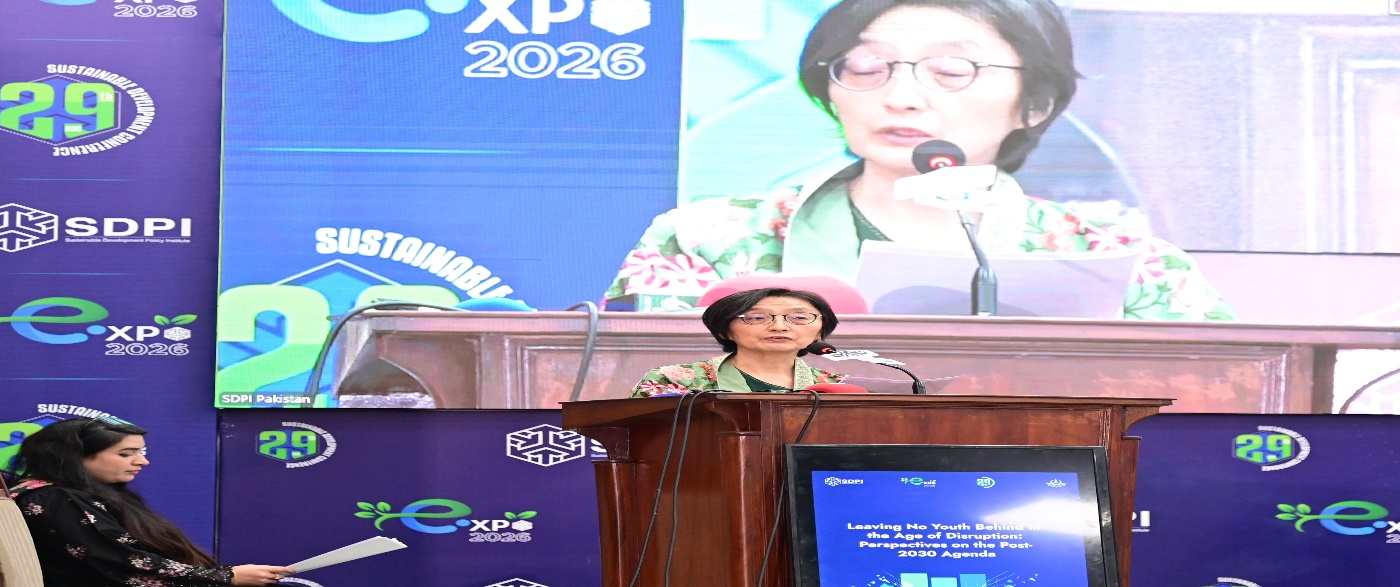
ISLAMABAD (03 November 2026): The widening digital divide can turn technological progress into another faultline of inequality, making access to the jobs of tomorrow increasingly out of reach for young Pakistanis, warned Ms Mikiko Tanaka from Subregional Office for South and South-West Asia, United Nations Economic and Social Commission for Asia and the Pacific (SSWA-UNESCAP)
She was speaking at the session, ‘Leaving No Youth Behind in the Age of Disruption: Perspectives on the Post-2030 Agenda’ at the Sustainable Development Conference organized by the Sustainable Development Policy Institute (SDPI).
Ms Tanaka said that while disruption and artificial intelligence hold immense potential for job creation, economic growth and more resilient societies, their benefits are far from guaranteed. Deployed effectively, emerging technologies can expand employment opportunities for young people, she said, adding that without equitable access and responsible application, they risk deepening existing disparities and entrenching exclusion. She noted that young people must not merely be the recipients of the post-2030 development agenda, but active participants in shaping it.
Taking the discussion from the challenges of technological disruption to the policy responses needed to address them, Arsalan Ahmed Raja of the Prime Minister’s Youth Programme (PMYP) spoke about the government’s efforts to equip young people with the skills, opportunities and institutional support needed to navigate a rapidly changing world.
Mr Raja said the government aims to ensure that, by 2030, all approximately 2.3 million young people entering the workforce are absorbed into productive employment. “By 2030 we also want to make sure that women represent at least 30 % of the workforce,” he said. He also shared other policy measures, saying that the Cabinet had already approved the National Adolescent and Youth Policy and the eSports Policy.
Danish Tariq, from the Regional Caucus for South Asia, United Nations Major Group for Children and Youth, said Asia and the Pacific is on track to miss 88 per cent of the Sustainable Development Goals (SDGs). He also pointed out the absence of consolidated data to identify which segments of society are most affected by this shortfall. “We need to move on from asking what young people can do for development and ask if the development organizations and the government are ready to listen to the youth and offer meaningful representation,” he said.
CEO of Native Youth Club for Climate Change (NYCCC), Umair Mufakir, noted that Pakistan is among the countries facing the highest risks associated with climate change, and shed light on the initiatives undertaken by his organisation to promote climate action. “We focus on holding awareness sessions for local communities in their local languages,” he said, adding that the NYCCC has also proposed ‘adaptation grants’ to be included in government programmes to incentivize climate adaptation.
Mr Muhammad Shayan Azmat, Education and Development Expert, observed that while Pakistan had made progress on some Sustainable Development Goals (SDGs), its performance on others had regressed further. Challenging the audience to reflect on the effectiveness of the country's education system, he asked how many could still recall the mathematical formulas they had been taught in school.
Dr Sadya Salar from Khawaja Sira Society and a transgender rights activist, highlighted the importance of inclusivity, tolerance and societal acceptance in creating an environment where young people can thrive and contribute meaningfully to society. She stressed that individual potential cannot be realized without a supportive social ecosystem.
“Children who have to run away from their families just to survive cannot be expected to focus on education or climate issues,” Dr Salar said, adding that building an inclusive society requires language literacy and collective efforts to extend support and recognition to all members.
Ms Asifa Jamali from Welfare Association for New Generation (WANG) Balochistan, shed light on the gaps in facilities and opportunities available to the youth in different parts of the country. She identified three different types of disparities, including ‘infrastructure and internet’, ‘language barriers’, and ‘skills and confidence’ gaps.
Dr. Asim Rehman, Director Policy & Sustainable Development, of Environment Protection and Climate Change Department Punjab shed light on the measures taken by the Punjab government towards climate action and environmental conservation.
MPA Hafiz Muhammad Tahir discussed the interconnected challenges of climate change, employment and self-reliance. He reiterated the need for policies that address these areas together and spoke on the importance of equipping young people with the skills, resources and opportunities to become economically independent while building resilience against the growing impacts of climate change.
Delivering the concluding remarks, MPA Ahmad Iqbal Chaudhary commended SDPI for bringing youth representatives to the table and providing them a platform to articulate not only the challenges they face but also the frustration and urgency behind their demands. “We not only heard their concerns but also the anguish behind their concerns,” he said.
Painting a sobering picture of Pakistan’s outlook for 2030, he said that governments and larger institutions often struggle to keep pace with disruption, adapting and transforming far more slowly than the challenges demand. He urged the youth to remain vigilant, hold the government accountable and actively push for greater representation through local government structures. He noted that meaningful change would require youth to move beyond being passive recipients of policy and become active voices in governance, decision-making and the shaping of their own futures.