Digital training must translate into business opportunities for women: Experts, Day 2, A10, 03 Nov
Digital training must translate into business opportunities for women: Experts
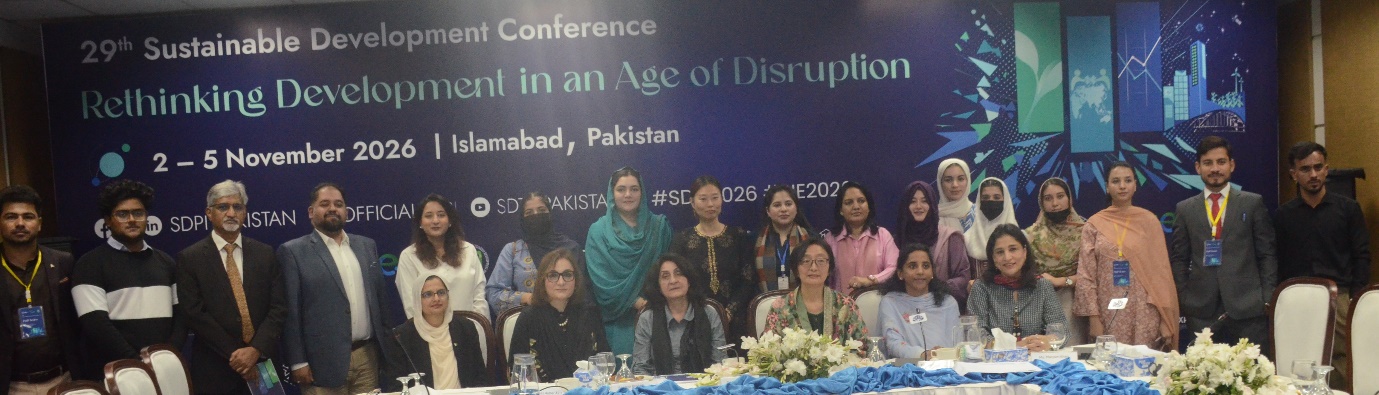
ISLAMABAD (03 November 2026): Experts at a session called for a coordinated national effort to equip women entrepreneurs with digital skills, improve their access to markets and finance, and simplify business registration and export procedures, saying technology-based training could deliver meaningful results only when linked with practical business opportunities.
The session, titled: “Digital Skill Development of Women Entrepreneurs on Enhancing Business Opportunities”, was organized on the second day of the 29th Sustainable Development Policy Institute by the Sustainable Development Policy Institute (SDPI) in collaboration with the United Nations Economic and Social Commission for Asia and the Pacific (UNESCAP)Tuesday.
They stressed the need for a national digital marketplace, stronger public-private partnerships, product development, accessible financial services and institutional coordination to help women-led businesses expand beyond local markets and compete internationally.
Mikiko Tanaka of the UNESCAP Subregional Office for South and South-West Asia, India, in her opening remarks, said digital technologies and artificial intelligence (AI) were creating new opportunities for women entrepreneurs to promote products, reach customers in other cities and countries, receive digital payments and explore international markets.
She said AI tools could help small businesses prepare marketing material, identify potential markets, communicate with customers and manage routine tasks. However, simply having an online presence did not guarantee business growth, as women entrepreneurs continued to face challenges in finding reliable buyers, managing delivery costs, understanding export procedures and receiving international payments. She said digital skills must therefore be connected with practical business knowledge and access to markets.
She said Pakistan had considerable potential in sectors such as textiles, handicrafts, food products and services, but women entrepreneurs needed reliable information, affordable logistics, access to finance and effective business support to connect with regional and global value chains.
Mehnaz Akber Aziz of the Centre for Governance and Public Policy (CGNP) called for establishing a national digital marketplace to connect women entrepreneurs with buyers and provide them with greater visibility in domestic and international markets.
Sharing her observations from the Lok Virsa Mela, she said women involved in handicrafts and traditional embroidery from Balochistan, Sindh, Khyber Pakhtunkhwa, South Punjab and other regions were running promising businesses, often without adequate government support.
She said many women had started selling products online during the COVID-19 pandemic and had developed their own customer networks. However, they continued to face difficulties in accessing exhibitions, business registration, institutional assistance and digital platforms.
Aziz said Pakistan needed a system to identify, register and connect women entrepreneurs with available support services. She also emphasised the need to improve product design, branding and marketing rather than relying solely on traditional handicraft production.
Tayaba Batool of Capacity Analytics highlighted the importance of linking digital skills training with trade procedures, market requirements and institutional support. She said her organisation, in collaboration with UNESCAP and the Trade Development Authority of Pakistan (TDAP), had conducted workshops to help women entrepreneurs use digital tools to identify buyers, understand markets, present products and meet the requirements of importing countries.
She said another area of work involved strengthening women's representation in trade organisations and chambers. Following the Trade Organisations Amendment Act, awareness sessions and consultations were held in 2025 with the Ministry of Commerce and the Directorate General of Trade Organisations to involve women and smaller chambers in discussions on changes to trade organization rules. Batool said strong women chambers were essential to ensure that business support services reached a wider number of women entrepreneurs.
She proposed establishing a working group on women in trade, bringing together the Ministry of Commerce, chambers of commerce, the Federation of Pakistan Chambers of Commerce and Industry (FPCCI) and other relevant organisations to identify barriers and develop practical solutions.
Maryam Khan of the South Asia Women Development Forum said complicated tax and registration procedures discouraged many women from formally registering their businesses.
She said women entrepreneurs also needed greater access to product development, design and market information to make their goods competitive internationally.
Khan observed that many women were still producing traditional products without sufficient knowledge of changing consumer preferences and international market requirements. She said AI could support product innovation and design, but entrepreneurs needed to learn how to use the technology effectively by asking relevant questions and applying its results to their businesses.
She also stressed the importance of developing value chains by connecting women with different skills, such as embroidery, stitching and product design, so they could work together to produce marketable goods.
Laraib Ghaffar, Deputy Collector Customs and subject matter expert at Pakistan Single Window (PSW), briefed participants on the role of digital trade facilitation in helping women entrepreneurs enter cross-border markets.
She said PSW provided an electronic platform through which traders could submit cross-border trade declarations to Pakistan Customs and other relevant regulatory departments through a single system.
She said the platform had more than 100,000 subscribers, including women traders, and was connected with 29 authorised commercial banks and more than 32 government departments.
Ghaffar said digitalisation reduced the need for traders to visit multiple government offices, submit the same documents repeatedly or undergo separate verification procedures for each department.
She said the programme offered a dedicated 24-hour helpline for women traders and worked with relevant institutions and women chambers to identify entrepreneurs ready to export their first shipment.
Ms Rabia Riaz Corporate Communications Manager, PepsiCo Pakistan, said digital tools alone could not ensure business growth unless women entrepreneurs were trained to use them to improve productivity, reach new customers, price products appropriately, receive payments securely and manage orders.
Referring to PepsiCo's “She Feeds the World” initiative, implemented in southern Punjab in collaboration with the PepsiCo Foundation and CARE International, she said female farmers in Bahawalpur and Okara had received training in sustainable agriculture, savings and financial literacy.
She said a Village Savings and Loan Association established under the programme had mobilised Rs8.9 million, enabling women in the community to access savings and loans and start small businesses.
She stressed that government institutions, development partners, chambers of commerce and the private sector needed to work together to expand such opportunities and ensure that training translated into sustainable economic activity.
In her closing remarks, Senator Roshan Khursheed Bharucha, Member of the Judicial Commission of Pakistan and Member of the Board of Governors of SDPI, emphasised the importance of capacity-building and skills development in enabling women to participate in economic activities.
She said complicated procedures and frequent regulatory changes often discouraged women from registering businesses and entering formal markets. Referring to her experience in Balochistan, she said some women avoided registration because they feared it would expose them to additional tax liabilities.