Experts call for regional cooperation to address water security challenges, promote hydro-diplomacy, peace, Day 2, A13, 03 Nov
Experts call for regional cooperation to address water security challenges, promote hydro-diplomacy, peace
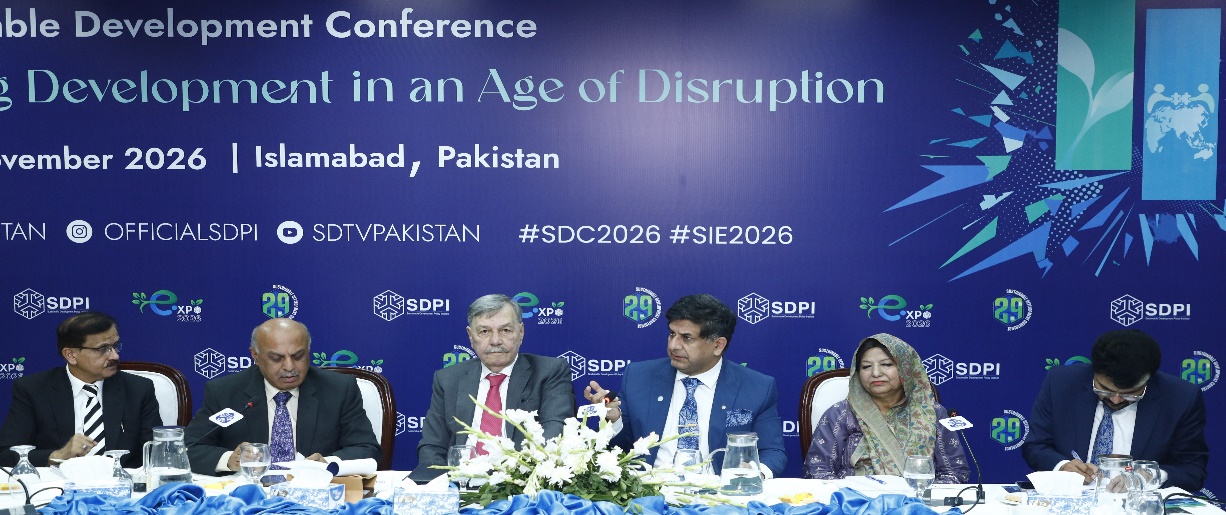
ISLAMABAD (03 November 2026): Water experts have called for shared efforts to address common water security challenges in South Asia, particularly between Pakistan and India, stressing that cooperation, effective water management and respect for international agreements were essential to prevent further tensions and safeguard the region's future.
They were speaking at a session, titled: "Water Security, Hydro-Diplomacy & Regional Peace", organized at the 29th Sustainable Development conference by Sustainable Development Policy Institute (SDPI) here on Tuesday.
The experts emphasized that Pakistan needed to pursue its rights under the Indus Waters Treaty at bilateral and international forums while strengthening its domestic water governance, implementing existing policies and improving conservation practices.
Chairperson of the Board of Governors of the Sustainable Development Policy Institute (SDPI), Ambassador Shafqat Kakakhel, described water as an existential issue, saying it was the fundamental prerequisite for all forms of life.
He said the Indus Waters Treaty was an extraordinary agreement negotiated at a time when international water law was still underdeveloped. The treaty not only prevented a potentially devastating conflict between Pakistan and India but also established principles that were subsequently incorporated into the United Nations Watercourses Convention.
"Number one, it resolved what could have been a potentially intractable problem given the history of India and Pakistan. It would have been a deadly conflict," he said.
Explaining the treaty's distinctive arrangement, Ambassador Kakakhel said the six rivers of the Indus basin were divided between the two countries, with India obtaining complete control over the eastern rivers and Pakistan receiving the western rivers, subject to certain conditions allowing India to construct hydropower projects.
He said the treaty introduced the run-of-the-river concept to ensure that Indian hydropower projects did not result in substantial losses of water for Pakistan. The arrangement allowed limited pondage rather than large-scale storage, with 3.6 million acre-feet fixed for India's permitted uses.
Referring to the National Water Policy introduced in 2018 and the subsequent implementation strategy prepared by the Pakistan Council of Research in Water Resources in 2022, he regretted that policies and plans often remained unimplemented.
"This is the basic tragedy of Pakistan; that you make agreements, you make plans, you make strategies, and they collect dust. Dust in the offices," he said, calling for an end to the practice and urging the country to conserve every drop of water.
He also pointed out that Pakistan's per capita water availability had declined from 5,200 cubic metres to 800 cubic metres, while its population had increased from 31 million at the time of Partition to around 250 million.
Former chairman of the Federal Flood Commission under the Ministry of Water Resources, Ahmed Kamal, said Pakistan could not afford to treat the Indus Waters Treaty as a matter of history, particularly when India was pursuing projects on the ground.
He urged Pakistan to pursue the treaty at all relevant forums and make efforts to revitalise the Permanent Indus Commission to restore regular meetings, engagement and data exchange between the two countries.
"If that is not done, then we should go, as we are also doing already, to international forums, including the United Nations," he said.
Mr Kamal also called for stronger engagement with the United Nations Secretary-General's representative on water-related issues to promote international efforts towards addressing transboundary water disputes.
Emphasizing the need for domestic institutional reforms, he said Pakistan had failed to give adequate attention to its National Water Council, which had held only one meeting on October 25, 2018, since the National Water Policy was approved. Five members from the private and civil sectors were still to be appointed.
He said the National Water Conservation Strategy, prepared by April 2024 and presented to the highest forum, had also failed to receive the required attention despite containing important recommendations.
"If that conservation strategy was approved at that time, whatever extra water that we got during 2025 monsoon and then in 2026 monsoon, that could have been saved locally for the benefit of the people," he said.
Dr Shaheen Akhtar from National Defence University said regional cooperation had considerable potential to strengthen water security, although the suspension of SAARC's activities and strained relations between Pakistan and India had weakened prospects for collective action. She said the Indus Waters Treaty remained the strongest water-sharing framework in the region, containing detailed provisions governing the rights of both countries and technical requirements for run-of-the-river projects.
However, she identified differences over the interpretation and implementation of technical provisions, particularly sediment management, as a major source of friction.
"These rivers carry a lot of sediments, they are flash, fast-flowing rivers. So, it's very difficult actually when you have cascading dams, you trap the sediment, so obviously it's going to affect not only the river hydrology, but also the sediment issue," she said.
Dr Akhtar said geopolitical tensions and power asymmetries had influenced the treaty since its negotiation, while climate change, population growth, energy needs and rising water demands had further complicated the situation.
Global development leader Nabeel Goheer said the water dispute was much broader than a sectoral or security issue, linking it to economic development, human welfare, climate change and relations between the two countries. He said Pakistan and India could either focus on addressing common challenges, including poverty and social exclusion, or continue creating problems for each other.
Describing the dispute as a moral issue, he questioned the implications of statements suggesting that not a single drop of water would flow to Pakistan. "What does it mean? Is it a direct right to kill the people of Pakistan with thirst and hunger?" he said.
Mr Goheer acknowledged that diplomatic and political conditions were currently unfavourable, with formal dialogue stalled and people-to-people interaction limited. He also regretted that political rhetoric and election-oriented statements were deepening divisions. However, he said there was still hope for a return to negotiations, urging both countries to rebuild trust, respect each other's concerns and avoid further confrontation. "This world could not afford another conflict between two nuclear states. It's a matter of choice at the end," he said, adding: "Let's choose to talk, let the conversation flow and let the water flow.”