From Skills to Economic Independence: Expanding Opportunities for WomenFrom Skills to Economic Independence: Expanding Opportunities for WomenFrom Skills to Economic Independence: Expanding Opportunities for Women, Day 2, A1, 03 Nov
From Skills to Economic Independence: Expanding Opportunities for Women
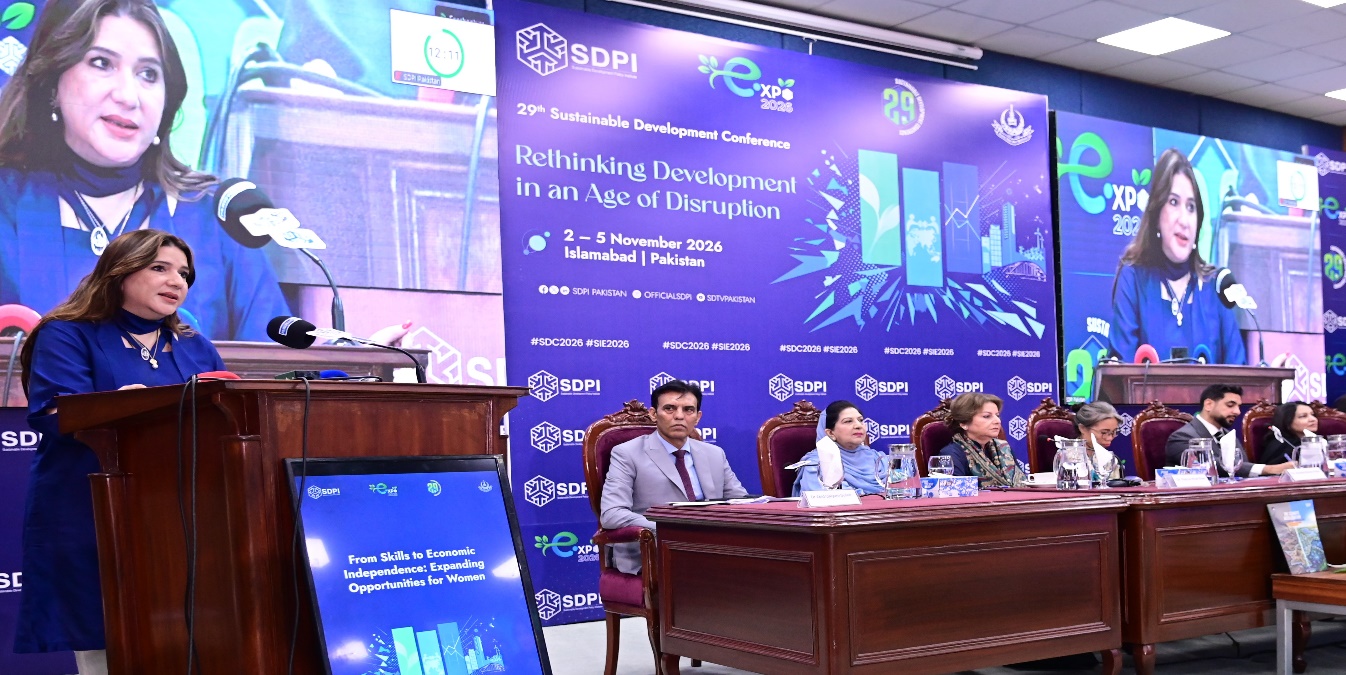
ISLAMABAD (03 November 2026): Experts have explored strategies to bridge existing gaps, expand access to economic opportunities and strengthen women’s participation in the workforce and broader economy.
Speaking in the session titled “From Skills to Economic Independence: Expanding Opportunities for Women,” held on the second day of 29th Sustainable Development Conference organized by Sustainable Development Policy Institute in collaboration with L’Oreal Pakistan, here at Allama Iqbal University Open University on Tuesday.
Member of National Assembly Shaista Pervaiz Malik noted that while skills are the “key” and economic empowerment is the “house”, five critical doors in between them require to be opened: skills, safety, capital, markets and health.
She stressed the need to examine what institutional and market-level changes are required across these five areas to remove existing barriers and create an enabling environment where women can fully participate in and benefit from economic opportunities.
SDPI Executive Director Dr Abid Qaiyum Suleri highlighted the importance of what he described as a “golden triangle” of skills, finance and market access, noting that all three elements must be in place and work in tandem to translate women’s skills into meaningful economic opportunities. He called for broadening the discussion to include the insurance and microfinance sectors, noting that their involvement is essential to strengthening this ecosystem and ensuring that women have the financial support and market linkages needed to turn their skills into sustainable livelihoods. As he put it, “So let’s add the insurance sector and the microfinance sector to this debate and make sure the triangle works well.”
Dr Van Nguyen, Deputy Resident Representative, United Nations Development Programme (UNDP) Pakistan, took the conversation beyond the persistent challenges and opportunities and asked the participants that “why do women have to overcome so many obstacles just to exercise their right to employment?”
Sharing a success story from a UNDP programme in Gilgit-Baltistan, she highlighted how enabling women to translate their existing skills and talents into income-generating opportunities can have an impact far beyond individual economic empowerment. She noted that when women are able to earn a livelihood through their skills, the benefits often extend to their families, creating better educational and living opportunities for their children and generating positive change across generations.
She also spoke on the challenges that remain even after trainings, for instance the transportation and mobility to markets, lack of child care at home. “Trainings should be connected, from the beginning, to markets and buyers,” she noted, adding, “the question is not what more women need to do, but what we need to change.”
Punjab Social Protection Authority, Vice Chairperson, Jahanara Manzoor Wattoo also spoke at the session and said that skills are “power, dignity and currency for economic empowerment” for everyone, but the social protection and focus is skewed toward women because poverty is skewed toward women.
CEO of L’Oréal Pakistan Rehan Saeed highlighted the alarmingly low participation of women in Pakistan’s workforce, and spoke on the persistent barriers that continue to limit their economic participation. These include workplace harassment, street harassment and other safety concerns that restrict women’s mobility, access to employment and ability to participate fully in the economy.
Public health, Gender Justice Expert, Dr Rakhshinda Perveen, noted that while there are numerous skills training programmes being carried out across the country, “skill development alone is not enough for women empowerment.” She identified three interlinked categories of challenges hindering women participation: legal and institutional challenges, societal challenges, and economic challenges.
Dr Perveen posed the question that “we are encouraging women to be more visible, but are the mechanisms to keep them safe also keeping up?” She said that presence is not the same as participation and participation is not the same as empowerment.
Punjab Ombudsperson for Protection of Women in the Workplace, Dr. Najma Afzal Khan, highlighted how concerns over personal safety and workplace harassment can undermine women’s ability and willingness to participate in the workforce. She noted that even qualified and capable women may find their professional potential compromised when their safety is threatened. She also noted that many women hesitate to report harassment due to the fear of retaliation or losing their jobs.
Speaking on the way forward, Dr. Khan said that the success of vocational training and skills development programmes should not be measured merely by the number of women trained, but by how many are able to translate those skills into tangible economic opportunities, and that it needs to be tracked that how many women go on to enter the workforce, secure employment, establish their own businesses and grow them into sustainable enterprises. “A woman’s right to employment must also be accompanied by her right to dignity and safety,” she said.