One Firm, Many Regulators: The Case for Regulatory Harmonisation, Day 2, A8, 03 Nov
Experts call for harmonized regulations, mutual recognition and stronger accountability to reduce business costs
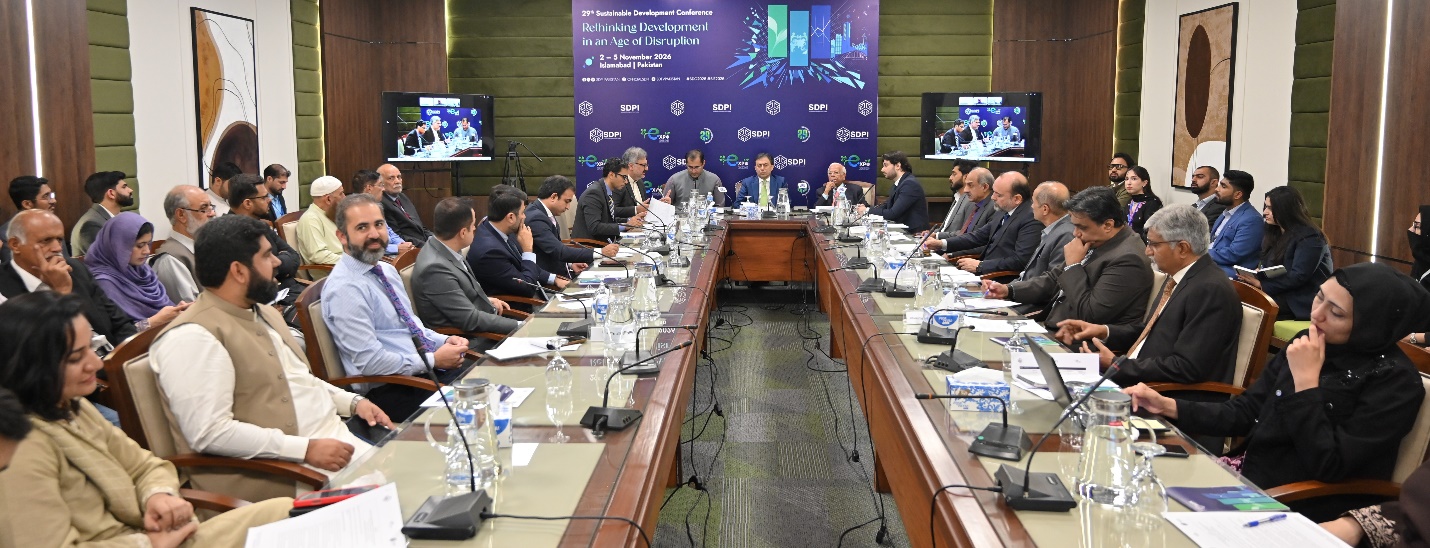
ISLAMABAD (03 November 2026): Business representatives and policymakers have called for coordinated regulatory reforms, harmonized standards and stronger accountability of regulatory institutions to reduce the compliance burden on businesses operating across Pakistan’s federal and provincial jurisdictions.
The discussion was held at a session, titled: One Firm, Many Regukators: The Case for Regulatory Harmonisation’, organized by Sustainable Development Policy Institute’s 29th Sustainable Development Conference, here on Tuesday.
Farid Ahmad Tarar, Chairman, Competition Commission of Pakistan (CCP), highlighted the difference between business facilitation initiatives and broader regulatory reforms.
He said Asan Karobar initiative represents only one part of the wider reform agenda. He recalled that businesses previously had to file up to 16 tax returns in a month with different federal and provincial departments, leading to the establishment of a common forum to harmonise returns. He also cited an engagement with the Lahore Chamber of Commerce, where around 150 businesses and industrial representatives were briefed on the CCP’s mandate.
Dr Ishrat Husain, former Governor of State Bank, appreciated the contributions and knowledge shared by the panellists and acknowledged the interest shown by the audience. He emphasised the importance of maintaining a balance between regulation, deregulation and over-regulation.
Dr Irfan noted that businesses expanding from one city or province to another face additional compliance requirements because of differences between federal and provincial jurisdictions. Referring to Article 151 of the Constitution, he described the multiplicity of regulations as a persistent challenge and highlighted the limited research estimating the additional costs arising from these differences. He also referred to federal and provincial Asan Karobar initiatives, including plans for a regulatory registry and business portal.
Usman Khan, Economist, said regulation should create fair, transparent and competitive markets, while unequal application of rules creates market distortions. Referring to Sialkot’s surgical instruments industry, he said that despite being 100 per cent export-oriented, businesses deal with approximately 28 departments and 36 regulatory requirements. He also cited an estimate of 1,003 federal and provincial regulators and called for a centralised digital registry and risk-based regulation.
Adeel Ibrahim, representing the private sector, shared concerns about differences in environmental approvals, documentation, reporting and compliance procedures across provinces. He recommended common application formats, standardised documentation and coordinated reporting systems to enable relevant authorities to access documents submitted in other provinces.
Nadir Mumtaz, former Chairman of KPT, described the Asan Karobar Act 2025 as a positive step for recognising hidden business costs. He highlighted the expenses involved in transporting goods from seaports to land borders across provinces. Although Pakistan Single Window provides digital services, he noted that physical intervention by clearing agents remains necessary in some cases. He added that Pakistan has 12 dry ports, many underused, while more than 95 per cent of goods are cleared at seaports.
Iqbal Sarwar, Khyber Pakhtunkhwa Board of Investment and Trade, shared the province’s experience with the Asan Karobar Act and its single-window portal. He explained that the Act provides for a digital portal and a Regulatory Reform Committee chaired by the Chief Minister, which can retain, simplify or remove regulations. He said 37 processes had been integrated and the beta portal was ready for further integration. However, some regulators had bypassed the portal and returned to face-to-face interactions. Manual records and resistance to digitisation also remained challenges. He noted that tourism and hospitality businesses may deal with 25 to 50 regulators.
Dr Muhammad Kamran Khan, University of Haripur, highlighted the gap between regulatory reform commitments and implementation. He said a request to convene the KP Regulatory Reform Committee had been submitted in February 2026, but the meeting had not taken place by the time of the discussion. He called for delegated authority and stronger monitoring. He also highlighted barriers faced by young entrepreneurs and freelancers, overlapping taxes and licensing charges treated as revenue. He recommended reviewing the concurrent legislative framework in light of the 18th Amendment and supported harmonisation and mutual recognition.
Dr Vaqar Ahmad, Economist, said Pakistan had made considerable progress and was not starting from zero. He noted that sector-specific discussions reflected greater space for dialogue on regulatory challenges. Sharing an example, he referred to an individual from Nepal who had received Pakistan’s online visa within 60 minutes, describing it as an indication of progress, although the pace of reform could be faster. He also encouraged stakeholders to read Dr Ishrat Husain’s reports on regulatory institutions and noted that startups were reporting easier online business registration, alongside improvements in filing and foreign direct investment systems.
Muhammad Asghar Nasar, SMEDA, highlighted the unequal application of regulations and the multiplicity of regulatory authorities. Referring to the surgical instruments industry, he noted that businesses face requirements from approximately 28 departments and 36 regulatory requirements. He called for harmonization, mutual recognition and a centralized digital registry, and stressed that reforms should be institutionalized through legislation to ensure continuity and improve export competitiveness.
Rafay Khan discussed the World Bank’s engagement in Pakistan’s business regulatory reforms, which began in 2016 under the Doing Business Report initiative. He said coordination between federal and provincial departments contributed to Pakistan improving its Doing Business ranking by 39 positions between 2016 and 2019. He noted that although the report was discontinued in 2019, the need for business regulatory reforms remained important beyond the reporting framework.
Asif Kareem, highlighted Sindh’s first end-to-end automated e-licensing portal, covering 150 services, developed with World Bank support. The portal enables online applications, processing, approvals and escalation. He also said Sindh’s draft Asan Karobar Act was awaiting consideration by the provincial cabinet. He called for inter-provincial harmonisation, an interoperability framework for recognising licences issued by other provinces, digital information-sharing, AI-enabled regulatory guidance and performance indicators to improve transparency and accountability.