Pakistan needs mandatory CSR law, innovative financing to bridge social sector funding gap: experts, Day 2, A11, 03 Nov
Pakistan needs mandatory CSR law, innovative financing to bridge social sector funding gap: experts
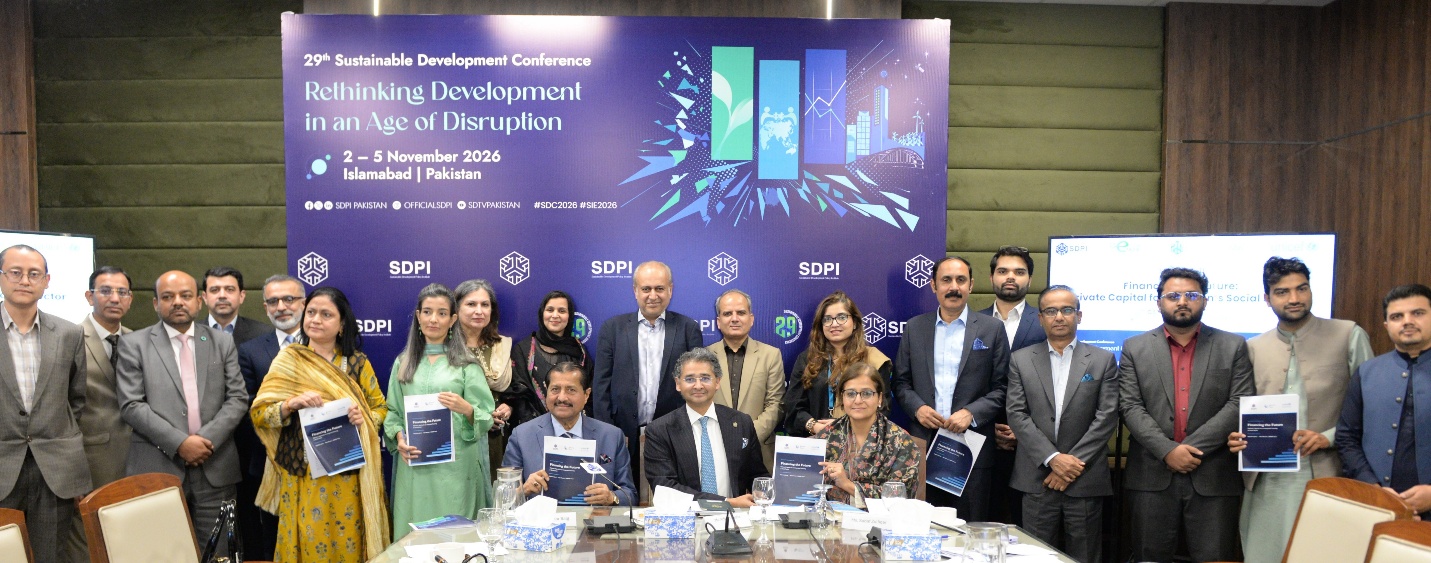
ISLAMABAD (03 November 2026): Pakistan needs a comprehensive legal framework to regulate corporate social responsibility (CSR) and make it mandatory for companies to allocate at least one percent of their profits to social development, while improving the efficiency of public spending and mobilizing private capital to address growing financing constraints in the social sector.
This was stated by the experts at a session, titled “Financing the Future: Private Capital for Pakistan's Social Sector” organized at 29th Sustainable Development Conference by the Sustainable Development Policy Institute here on Tuesday.
They stressed the need to move beyond conventional public financing and explore innovative funding mechanisms, stronger public-private partnerships and corporate contributions to support children, young people and vulnerable communities.
Mirza Ikhtiar Baig, Member of the National Assembly, said Pakistan lacked a proper legal framework to regulate CSR, unlike neighbouring and regional countries that had introduced mandatory corporate contributions towards social welfare.
He said India had made a two percent CSR allocation mandatory, while Sri Lanka and Nepal had set the requirement at one percent. Pakistan, however, had yet to introduce similar legislation.
Baig said the proposal to make one percent CSR spending compulsory had faced opposition from the Federal Board of Revenue (FBR) and the Securities and Exchange Commission of Pakistan (SECP). He expressed confidence that the proposed legislation would eventually be passed to ensure a regular corporate contribution towards social development.
He stressed that the corporate sector should play a more meaningful role in addressing Pakistan's development challenges rather than leaving the responsibility entirely to the government.
Sadaf Zulfiqar of UNICEF emphasised that public funds must be utilised efficiently and strategically to maximise benefits for children and the young population, particularly through improved access to essential services, education, healthcare and development opportunities. She said investment in children should not be viewed merely as a social obligation but as a strategic investment in Pakistan's future economic productivity and human capital.
She observed that Pakistan was facing severe resource constraints at a time when international development financing and foreign aid were shrinking, making it essential to explore alternative financing instruments and strengthen collaboration with development partners.
Zulfiqar said UNICEF's priorities included ensuring equitable financing for all children, improving public expenditure efficiency, enhancing value for money and directing resources towards the most marginalised children and underserved communities.
She stressed that efficient utilisation of available resources was as important as mobilising additional funding, as better spending could translate into improved outcomes for children and young people.
Adviser to the Finance Minister Adnan Pasha highlighted the importance of structural reforms and said international financial institutions, including the Asian Development Bank (ADB) and World Bank, were not merely asking Pakistan to announce reforms but also demonstrate their implementation and tangible results.
He also underscored the importance of CSR in mobilising additional resources for social sector development, suggesting that the private sector had an important role in complementing government efforts.
Representative of the Federation of Pakistan Chambers of Commerce and Industry (FPCCI) was also among the speakers at the session, which focused on mobilising private capital to support Pakistan's social sector priorities.
The discussion highlighted that Pakistan's growing development needs, limited fiscal space and declining external assistance required a shift towards more sustainable and diversified financing arrangements.
The experts emphasized that improving the quality of public expenditure, establishing an enabling regulatory environment for corporate contributions and attracting private investment could help bridge the social sector financing gap and ensure that resources deliver measurable benefits for the country's children and future generations.