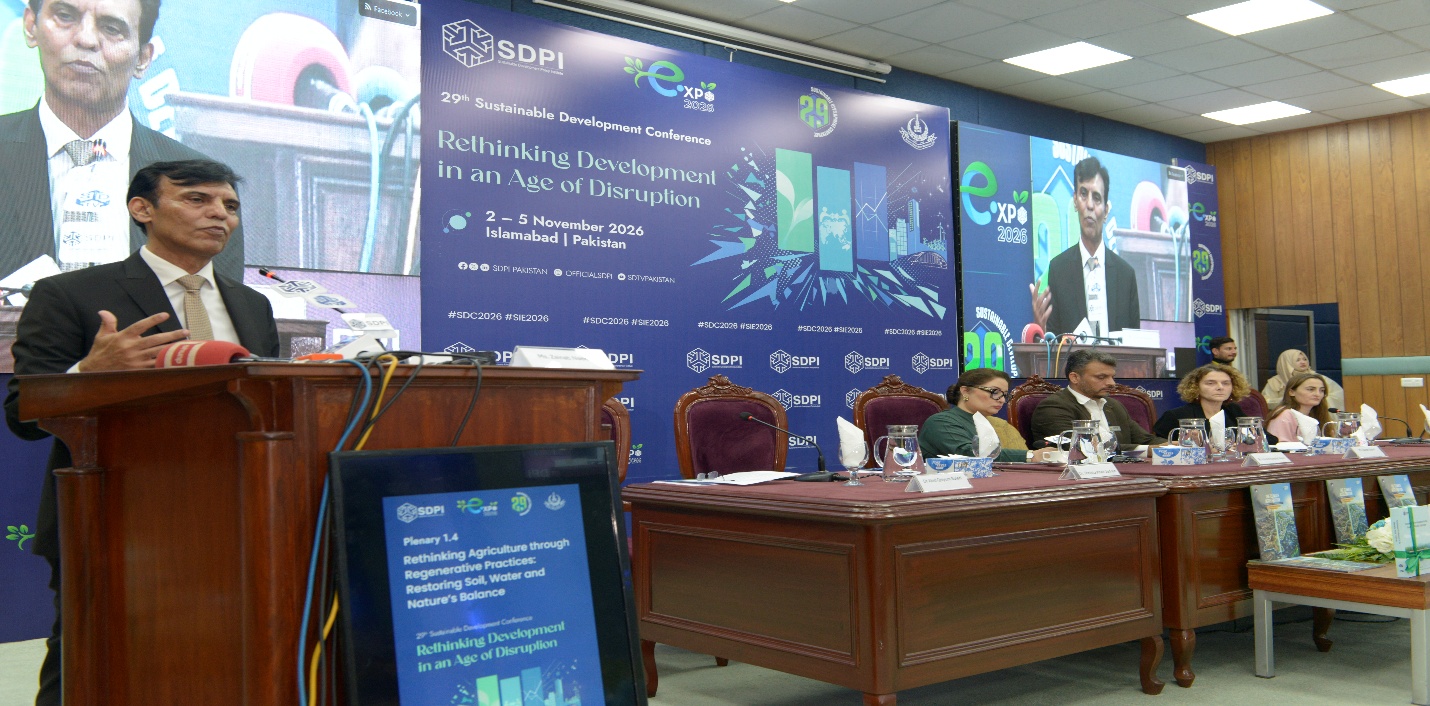
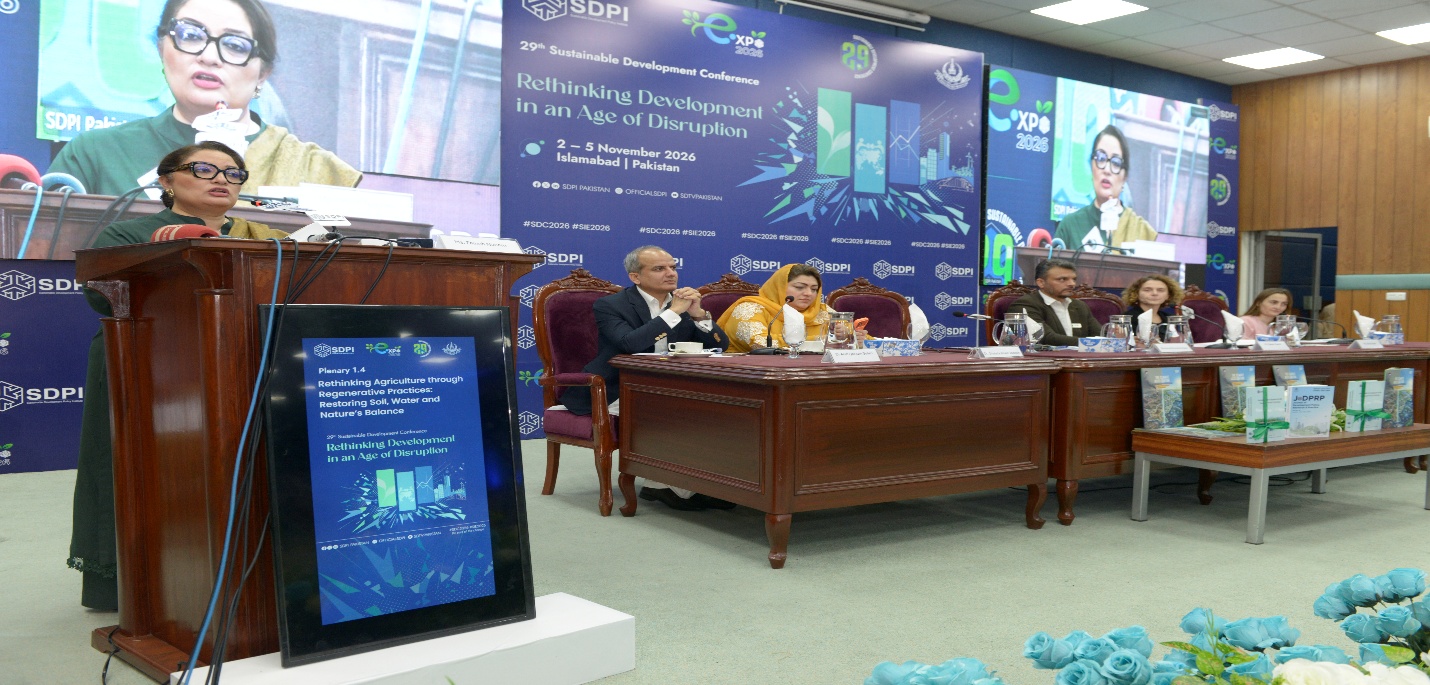
Rethinking agriculture through regenerative practices; restoring soil, water and nature's balance, Day 1, Plenary 1.4, 02 Nov
Rumina calls for shift to regenerative agriculture as water scarcity, food insecurity threaten Pakistan
Climate change, shrinking cultivable land making farming a riskier livelihood, warns Dr Suleri
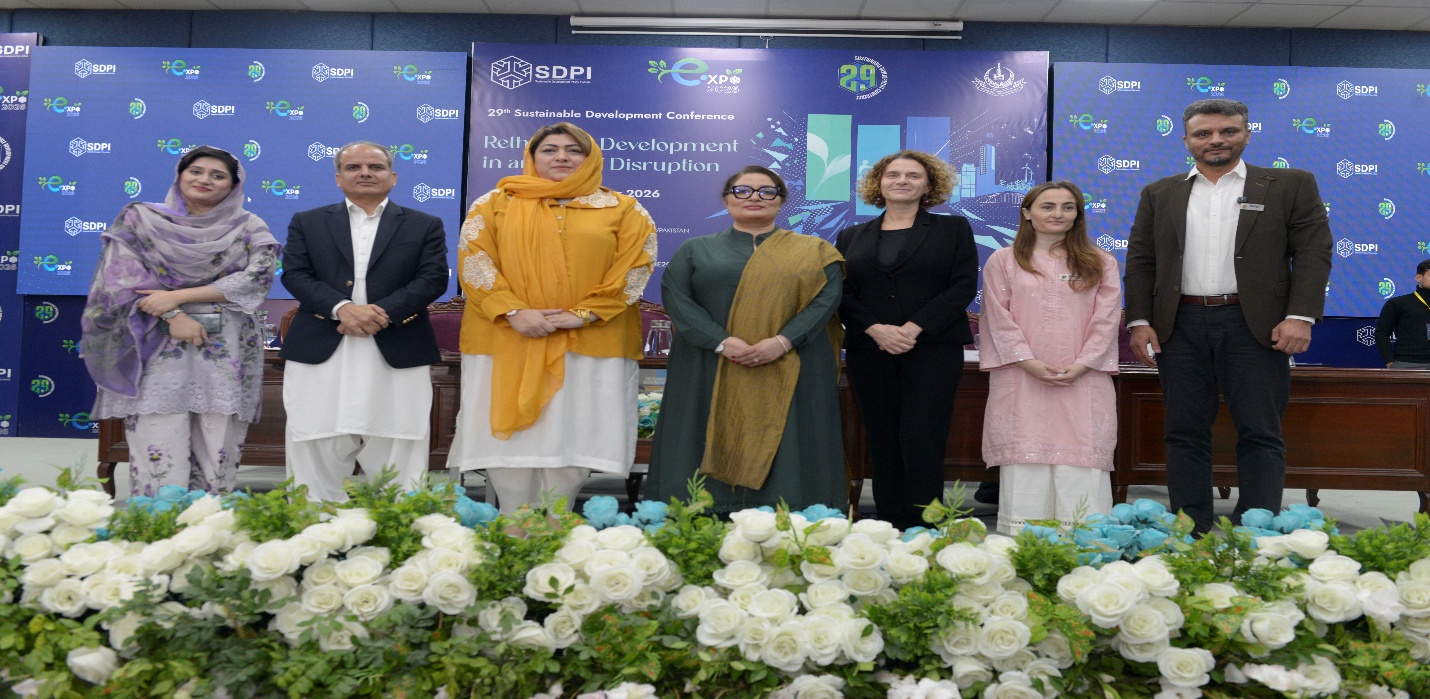
ISLAMABAD (02 November 2026): Coordinator to the Prime Minister on Climate Change Rumina Khursheed Alam has called for an urgent transition towards regenerative agriculture, warning that worsening water scarcity, climate-induced disasters and declining soil health are threatening Pakistan’s food security, agricultural productivity and rural livelihoods.
She was speaking at a plenary, titled: Rethinking agriculture through regenerative practices; restoring soil, water and nature's balance, organized at the 4-day 29th Sustainable Development Conference held by the Sustainable Development Policy Institute (SDPI) in collaboration with PepsiCo Pakistan on Monday,
“It's now or never. The way we grow our food must therefore be part of our response to water scarcity,” she said, stressing the need to restore soil health, conserve water and strengthen the resilience of farming communities against climate shocks.
Rumina said agriculture contributed 23.44 per cent to Pakistan's Gross Domestic Product (GDP) and provided employment to roughly one-third of the country's workforce, making climate-related disruptions in the sector a threat to the wider economy.
She said Pakistan's per capita water availability had declined to around 1,000 cubic metres annually, approaching the water-scarcity threshold, while more than 90 per cent of the country's water resources were consumed by agriculture.
She attributed mounting pressure on water resources to increasingly unpredictable rainfall, extreme weather events, groundwater depletion and rising demand, arguing that improved agricultural practices were essential to address the crisis.
Referring to the devastating 2022 floods, she said more than eight million people were displaced, while damage to agriculture and livestock was estimated at $3.7 billion. She said climate disasters were not only destroying crops and livestock but also causing psychological trauma, displacement and forced migration among farming communities.
Highlighting the regional dimension of the crisis, Rumina said the Indus was part of a transboundary river basin and called for cooperation on water data and early warning systems, as climatic changes in upstream mountain systems could directly affect farming communities downstream.
Parliamentary Secretary for National Food Security and Research Dr Shaista Khan Jadoon revealed that the proportion of Pakistani households experiencing moderate or severe food insecurity had increased to 24.3 percent in 2024-25 from 15.92 percent in 2018-19.
She said food security was not simply about the availability of food but also whether families could afford nutritious diets and farmers had the economic capacity and confidence to continue investing in their land.
She said the government was developing the Pakistan Food Security Information System under the Prime Minister's initiative, bringing together agricultural production and market-price information through commodity dashboards covering wheat, vegetables, pulses and cereals to facilitate timely policy decisions.
Dr Jadoon said the government was also working with provincial administrations on an agriculture sector roadmap focusing on mechanisation, access to finance and youth-related reforms.
SDPI Executive Director Dr Abid Qayum Suleri warned that climate change, shrinking cultivable land and increasingly extreme weather conditions were undermining agricultural productivity and making farming a riskier livelihood, discouraging younger generations from entering the sector.
He said the weakening of traditional family support systems was forcing farmers to depend on middlemen for diesel, fertilizer and pesticides on credit at exorbitant premiums, further eroding their earnings after harvest.
Zawar Kazmi, Head of Agro at PepsiCo Pakistan, said Pakistan's agricultural ecosystem was deteriorating, with soil quality, water availability and biodiversity facing growing pressure from environmental degradation and climate change.
He revealed that soil organic matter had fallen below 0.5 percent against an ideal level of more than 2 percent, warning that declining soil health was threatening the sustainability of agricultural production.
“At PepsiCo, we consider a farm as a living system and approach agriculture as one complete ecosystem,” he said, stressing that healthy soil, adequate water, energy and biodiversity were interconnected requirements for better crop yields and agricultural resilience.
Silvia Giada, Programme Manager at the United Nations Environment Programme (UNEP), Thailand, called for integrating ecosystem-based adaptation into agricultural practices to protect farmers and communities from climate change.
She said regenerative agricultural practices could contribute to ecosystem-based adaptation by strengthening agricultural resilience and protecting the ecosystem services on which farming depended.
She cautioned against adopting a uniform approach to climate adaptation, saying interventions must be tailored to the economic, environmental and ecological conditions of individual regions.
Anila Hakim, Agro Sustainability Lead at PepsiCo Pakistan, emphasised stronger collaboration between the private sector, government and farmers to build climate-resilient agricultural value chains.
She called for greater investment in modern technology, knowledge-sharing and sustainable farming practices to improve productivity, conserve natural resources and make Pakistan's agriculture sector more competitive.