Rethinking Development in an Age of Disruption
Ahsan calls for new global financial architecture to address debt, climate disruptions
Bangladeshi minister proposes industrial transformation, regional networks
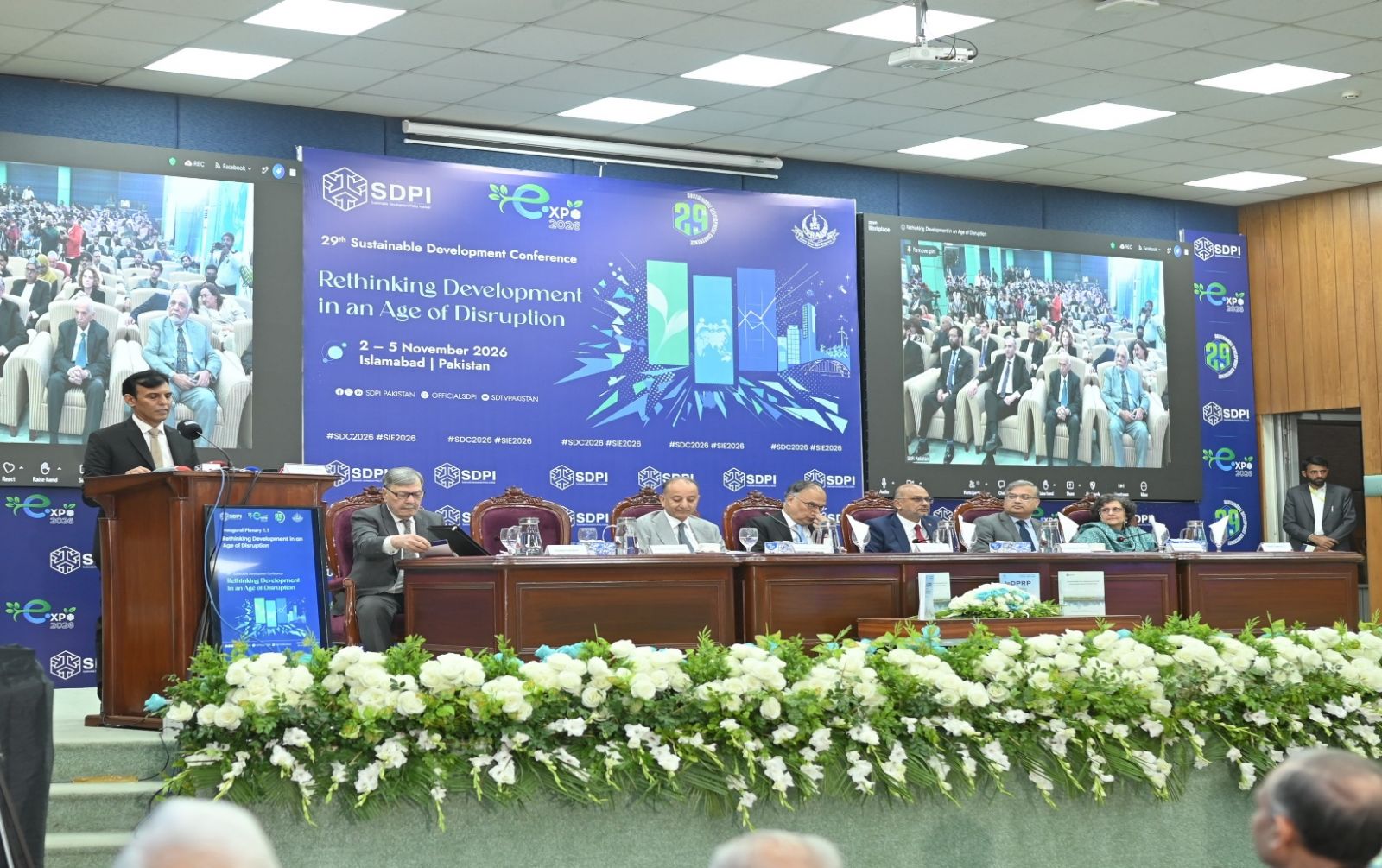
ISLAMABAD (02 November 2026): Minister for Planning Development & Special Initiatives Prof. Ahsan Iqbal has called for restructuring the post-Second World War international financial architecture to address mounting debt, climate disasters and technological disruptions.
He was delivering a keynote address at the opening ceremony of four-day 29th Sustainable Development Conference being organized by Sustainable Development Policy Institute at Allama Iqbal Open University here on Monday. The overarching theme of this year’s conference is ‘Rethinking Development in an Age of Disruption’.
Ahsan Iqbal said existing multilateral financial institutions lacked the capacity to respond to the development challenges of the 21st century, particularly climate change and the growing financial vulnerabilities of developing countries.
"These institutions have no space for climate challenge mitigation," he said, stressing the need for a new international financial architecture capable of supporting countries vulnerable to climate disasters and other emerging global challenges.
He called for a new global dialogue to restructure multilateral institutions, arguing that geopolitical conflicts, trade restrictions, sanctions and competition among major powers were increasingly influencing energy supplies, food prices, shipping routes, investment decisions and public finances. He further said Pakistan needs to adopt a proactive approach towards technological transformation through investment in foundational education, scientific research, technological absorption, entrepreneurship and institutional capacity.
"Countries that rely exclusively on low-cost labour as their competitive advantage will face growing challenges from automation and increasingly sophisticated robotics," he cautioned. Referring to the growing debt burden, Iqbal cited a UNCTAD report, saying 3.7 billion people lived in countries where public debt interest payments exceeded spending on health or education.
He said Pakistan had set an ambitious target of becoming a $1 trillion economy by 2035 and a $3 trillion economy by 2047, when the country would celebrate its centenary.
Advisor to Bangladesh Prime Minister Rashid Almehmood Titumir called for a new South Asian development paradigm based on industrial transformation, regional production networks, decent employment and stronger social protection. He said Bangladesh-Pakistan cooperation could set an example for the region.
He said the international economic and political order was undergoing structural transformation, requiring developing countries to rethink conventional development strategies and strengthen economic resilience.
"These disruptions are not merely external shocks to be absorbed. They are reshaping the conditions under which countries can industrialise, create employment, mobilize domestic resources, finance development and secure economic sovereignty," he observed.
Titumir proposed integrated production networks connecting South Asia, Southeast Asia and the Middle East and North Africa, bringing together primary, intermediate and finished-goods production. He said investment should build domestic capabilities, generate employment, transfer technology and strengthen linkages with the wider economy rather than merely attract capital. He also called for reinvigorating the South Asian Association for Regional Cooperation (SAARC) to address emerging economic challenges.
He said Bangladesh is now aspiring to become a manufacturing hub and export gateway, leveraging its strategic geographical location.
Federal Minister for Climate Change and Environmental Coordination Musadik Malik declared that Pakistan would no longer pursue development through additional borrowing, saying the country was open to equity investment and debt swaps but not further debt.
"That shop is closed. Whatever development we undertake must be fair, durable and genuinely ours," he said.
Malik said Pakistan collected around Rs16 trillion in revenue, of which approximately Rs8 trillion was consumed by debt servicing, accounting for 48-49 percent of total revenue.
"We are not opposed to debt swaps. We are willing to undertake development through debt swaps. We are open for business when it comes to equity, but we are not open to more debt," he said. He said Pakistan needed a development model that protected poor communities from repeated destruction caused by floods, glacier outbursts and extreme weather. Malik also called for recognizing extreme heat as a labour-rights issue, saying workers exposed to unbearable temperatures should receive paid leave without losing their income. "This is not merely weather. This is not simply climate. This is a tax imposed on poor people, a tax they pay through their own bodies," he said.
He also proposed using artificial intelligence to create employment opportunities for young people rather than displacing them, enabling graduates to train AI systems in regional languages, including Balochi, Brahui, Sindhi and Urdu. Malik announced a $10 million Green Field programme to provide young people with equity-based investment for scientific experimentation and innovative solutions, with the first competition planned within three months.
SDPI Executive Director Abid Qayum Suleri, Chairman SDPI Board of Governors Shafqat Kakakhel and Allama Iqbal Open University Vice-Chancellor Nasir Mahmood also addressed the inaugural session, highlighting the importance of sustainable development, regional cooperation and adapting development strategies to emerging global challenges.