Rethinking Development through the Three Es, Day 2, A4, 03 Nov
Major crops face yield losses under high-emission scenarios: experts
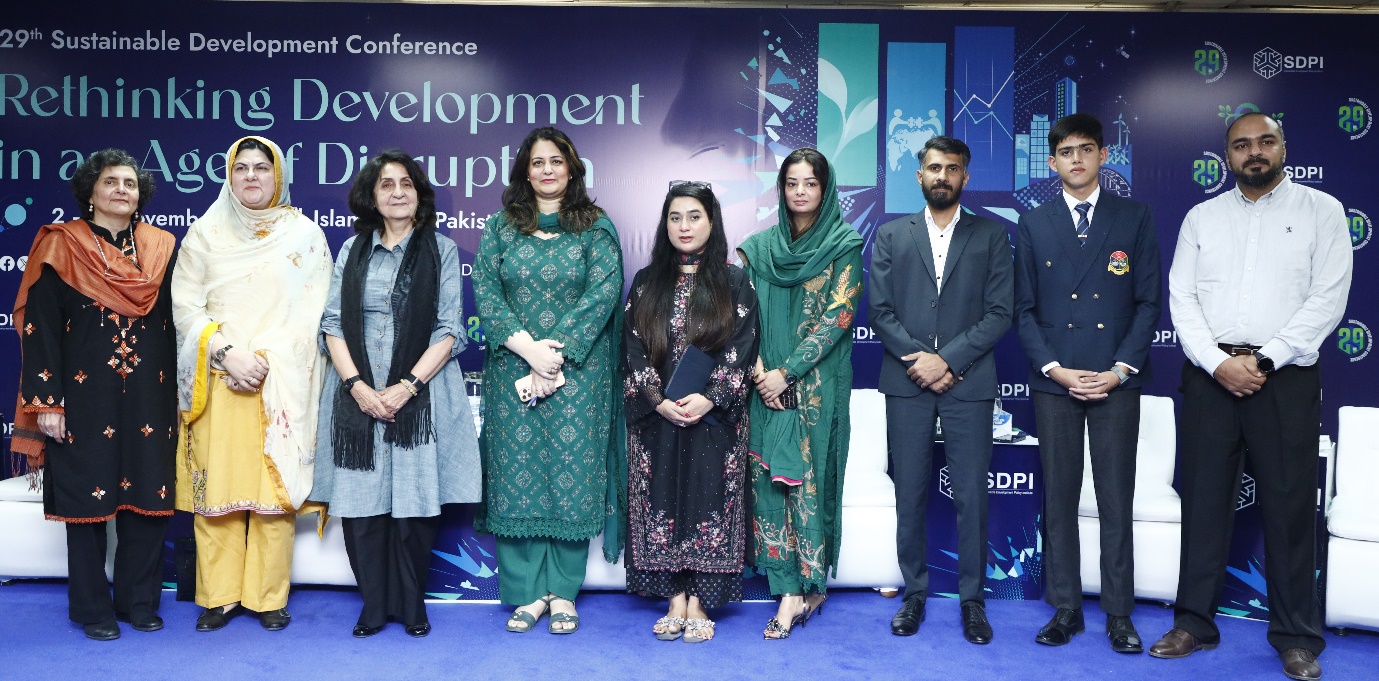
ISLAMABAD (03 November 2026): Pakistan could face substantial declines in the yields of major crops, including cotton, maize, rice and wheat, under future high-emission scenarios, therefore, there is an urgent need for climate-resilient agriculture, stronger adaptation measures and policies to protect vulnerable communities.
This was the crux of a session, titled: “Rethinking Development through the Three Es” held on the second day of the 29th Sustainable Development Conference, and organized by the Sustainable Development Policy Institute (SDPI) at Allama Iqbal Open University (AIOU).
Dr Muhammad Arshad Virk from University of Veterinary and Animal Sciences (UVAS), Lahore highlighted the potential of locally produced ethanol to reduce reliance on imported petroleum products, improve air quality and support economic stability.
Speaking on “From Smog Crisis to Green Opportunity: Mainstreaming Bioethanol for Sustainable Transport and Future Energy Security”, he said Pakistan's transport sector consumed around 80 per cent of the country's petroleum products and was a major contributor to air pollution, particularly in urban centres such as Lahore.
He said greater use of ethanol could diversify the country's fuel supply, reduce dependence on imported petroleum, save foreign exchange and lower transport-related emissions and particulate pollution. It could also help reduce healthcare costs associated with air pollution.
He pointed out that Pakistan's existing policy framework largely treated ethanol blending as voluntary, limiting the industry's potential. He said a long-term policy commitment was needed to encourage domestic consumption, improve investment confidence and ensure benefits for sugarcane farmers, agricultural workers and rural communities.
Ahmed Hassan Awan from Fatima Jinnah Women University, Rawalpindi argued that the country was moving towards ecologically informed development but had yet to achieve ecological security through effective policy implementation.
He said the environment provided the physical conditions necessary for development, the economy organised production and resource use, while equity determined how climate-related risks and benefits were distributed and whether vulnerable communities had a voice in decision-making.
He observed that climate finance, energy transition, infrastructure protection and nature-based solutions had received growing attention in national policy frameworks. However, he said environmental protection was often prioritised when its economic or human benefits could be demonstrated.
Bushra Yaqub of COMSATS University Islamabad discussed the gap between climate finance commitments and the delivery of resilient infrastructure to vulnerable communities.
Presenting her research on climate-resilient infrastructure in Pakistan, she said the country's exposure to floods, extreme rainfall, heatwaves and water shortages had highlighted weaknesses in infrastructure, public institutions, financial planning and disaster preparedness.
She stressed that economic, environmental and equity considerations should be integrated into infrastructure planning rather than treated as separate development objectives.
Fayaz Hassan of Wuhan University, China, examined Pakistan's export growth and transition risks in European Union markets covered by the Carbon Border Adjustment Mechanism (CBAM).
He said the mechanism was not merely an environmental regulation but also had implications for export competitiveness, market access and the distribution of adjustment costs.
Using Eurostat trade data at the eight-digit product level, he said Pakistan's exports of covered products to the European Union had increased from 5.46 million euros in 2017 to 50.87 million euros in 2025. Pakistan's ranking among developing-country suppliers had also improved from 45th to 33rd.
He also stressed the need to strengthen local verification capacity and provide technical assistance to smaller exporters so that the cost of meeting new environmental requirements did not exclude them from international markets.
Muhammad Abdullah Khan of Cadet College Hasanabdal highlighted the importance of making climate information accessible and understandable for smallholder farmers.
Presenting his research on an affordable, icon-based weather and crop guide, he said Pakistan had access to weather bulletins, forecasts and impact-based advisories, but many farmers could not translate technical information into timely decisions about sowing, irrigation and crop protection.
He proposed an offline guide using visual symbols and local-language instructions to help farmers understand weather information and take practical action.
Syed Iftikhar Ali, a power sector professional, discussed Pakistan's consumer-led solar transition and its implications for electricity planning, economic sustainability and social equity.
In his presentation, “From Grid Defection to Grid Participation”, he said the country's net-metered installed capacity had increased from 2.8 gigawatts to 7.3 gigawatts, reflecting a rapid shift towards distributed solar generation.
He said higher electricity tariffs and reliability concerns had encouraged households, businesses and industries to invest in solar systems. However, declining grid consumption did not automatically reduce network and capacity costs, which continued to require financing.
He warned that recovering these costs mainly through electricity consumption-based tariffs could increase the burden on consumers who remained dependent on the national grid, particularly low-income households, tenants and residents of apartments who had limited opportunities to install solar systems.
Amna Urooj of SDPI, presenting her paper “Burning Ground, Parched: Rethinking Climate Resilience through Environment, Economy and Equity in Pakistan”, said heatwaves and droughts should not be treated as separate environmental challenges because their effects were closely linked to economic security and social inequality.
She said smallholder farmers in South Punjab and arid areas of Sindh and Balochistan were particularly vulnerable because of limited access to insurance, climate information and financial protection.
She also highlighted the risks faced by residents of informal settlements, outdoor workers and women engaged in home-based work, who often had limited access to reliable electricity, water, ventilation and cooling facilities.
The discussants, Dr Shumaila Zeb of SZABIST, Islamabad, and Dr Samreen Fahim Babar of Quaid-i-Azam University (QAU), Islamabad, also shared their insights during the session.