Rethinking Supply Chains in an Age of Disruption: Sustainability, AI and Resilience, Day 2, A12, 03 Nov
Experts for strengthening supply chain resilience through localization, AI and infrastructure reforms
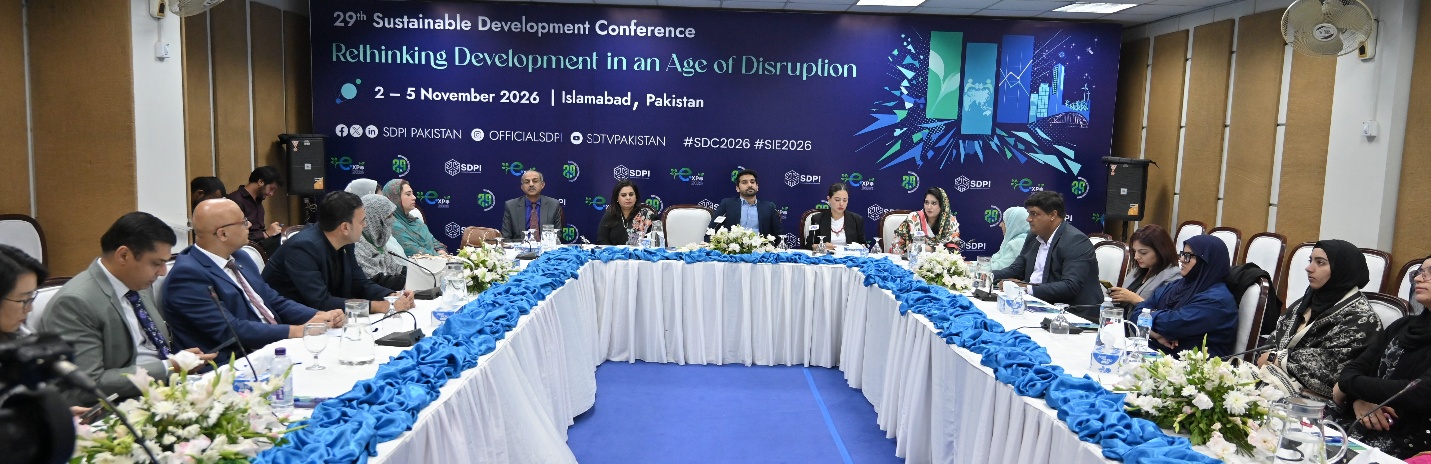
ISLAMABAD (03 November 2026): Experts at a session have called upon the government to prioritize industrial localization, artificial intelligence, strategic energy & food storage, and sustainable logistics infrastructure to protect Pakistan's economy against climate change, geopolitical tensions and global supply chain disruptions.
The recommendations emerged during a session titled “Rethinking Supply Chains in an Age of Disruption: Sustainability, AI and Resilience,” organized at the 29th Sustainable Development Conference by the Sustainable Development Policy Institute in collaboration with Packages Group here on Tuesday.
Muhammad Mir, Head of Supply, Planning and Logistics at PepsiCo Pakistan, stressed that localisation must involve developing complete domestic value chains rather than merely replacing international suppliers with local vendors.
He said PepsiCo was investing in tissue culture laboratories and greenhouse facilities to localise agricultural seed production. Through its Khud Mukhtar initiative, the company had also partnered with domestic manufacturers to develop industrial spare parts and reduce import dependence.
Highlighting technological innovation, Mir said PepsiCo was using satellite-based remote sensing, drone imagery and AI to identify water stress, crop growth deficiencies, adverse weather conditions and potential infestations before harvesting.
He recommended collective industry investment in local manufacturing capabilities, supplier development and technology transfer, supported by reliable data systems and robust business continuity plans.
Ayesha Aziz, Group Manager Sustainability at Packages Group, emphasized sustainable procurement and supplier capacity-building. She said large corporations must support smaller suppliers in improving environmental practices, data collection and compliance with international sustainability requirements.
Anam Zeb, Sustainability Expert at the International Finance Corporation (IFC), urged businesses to integrate climate risks into operational and financial planning rather than treating adaptation as a corporate social responsibility activity. She recommended that the Ministry of Climate Change and Environmental Coordination, provincial governments and industry associations facilitate climate-risk mapping, infrastructure vulnerability assessments and financial loss evaluations.
Commodore (Retd) Muhammad Irfan Taj, Senior Advisor on Maritime and Shipping Affairs, highlighted deficiencies in Pakistan's maritime infrastructure and called for improvements in petroleum handling facilities, port connectivity, shipping services and digitalisation.
He urged the Ministry of Maritime Affairs, port authorities and private investors to develop an integrated maritime strategy incorporating offshore petroleum facilities, sustainable bunkering infrastructure, aquaculture and greater investment in the blue economy.
Nadir Mumtaz, former Chairman of the Karachi Port Trust (KPT), highlighted Pakistan's dependence on imported hydrocarbons, inadequate petroleum and grain storage facilities, inefficient customs procedures and underutilized logistics infrastructure.
He argued that insufficient strategic reserves weakened the country's bargaining position in international energy markets and increased vulnerability to supply disruptions.
He recommended that the Petroleum Division, Ministry of National Food Security and Research and provincial governments prioritise petroleum storage facilities, modern grain silos and warehouse receipt financing mechanisms.
Mumtaz also called on the Federal Board of Revenue and Pakistan Single Window authorities to simplify customs clearance, improve documentation of cross-border trade and reduce cargo dwell times.
Highlighting the environmental impact of road-based freight, he urged the Ministry of Railways and relevant authorities to expand rail cargo services, examine the feasibility of inland waterways and develop integrated storage and logistics hubs.
Omer Salman, Senior Manager at A.F. Ferguson & Co., advocated life cycle assessments to identify environmental risks throughout supply chains. He recommended integrating sustainability considerations into business decisions and adopting internationally recognised disclosure frameworks, including IFRS S1 and S2 where applicable.
During the interactive discussion, a participant highlighted gaps in Pakistan's agricultural commodity ecosystem, including inadequate grain silos, limited independent grading facilities and underdeveloped commodity futures and options markets.
The participant stressed that warehouse receipt financing initiatives needed to be integrated with certified storage facilities, quality assessment services and commodity trading mechanisms to create a more efficient and resilient agricultural supply chain.
The session recommended that the Ministry of National Food Security and Research, Ministry of Finance, Securities and Exchange Commission of Pakistan, provincial agriculture departments, financial institutions and commodity exchanges jointly develop a framework for certified warehouses, standardised commodity grading, electronic warehouse receipts and agricultural price-risk management.
Concluding the discussion, the moderator urged the federal ministries concerned, regulators and policymakers to engage directly with industry representatives, maritime experts, academia and other stakeholders to translate the recommendations into practical reforms.
Highlighting growing geopolitical uncertainty and disruptions to the global order, she said resilience must extend beyond climate change and environmental sustainability to encompass the economic and operational consequences of policy decisions and international developments.
Participants called for coordinated government-industry action to strengthen domestic production, modernize infrastructure, improve regulatory efficiency and develop supply chains capable of withstanding future shocks.