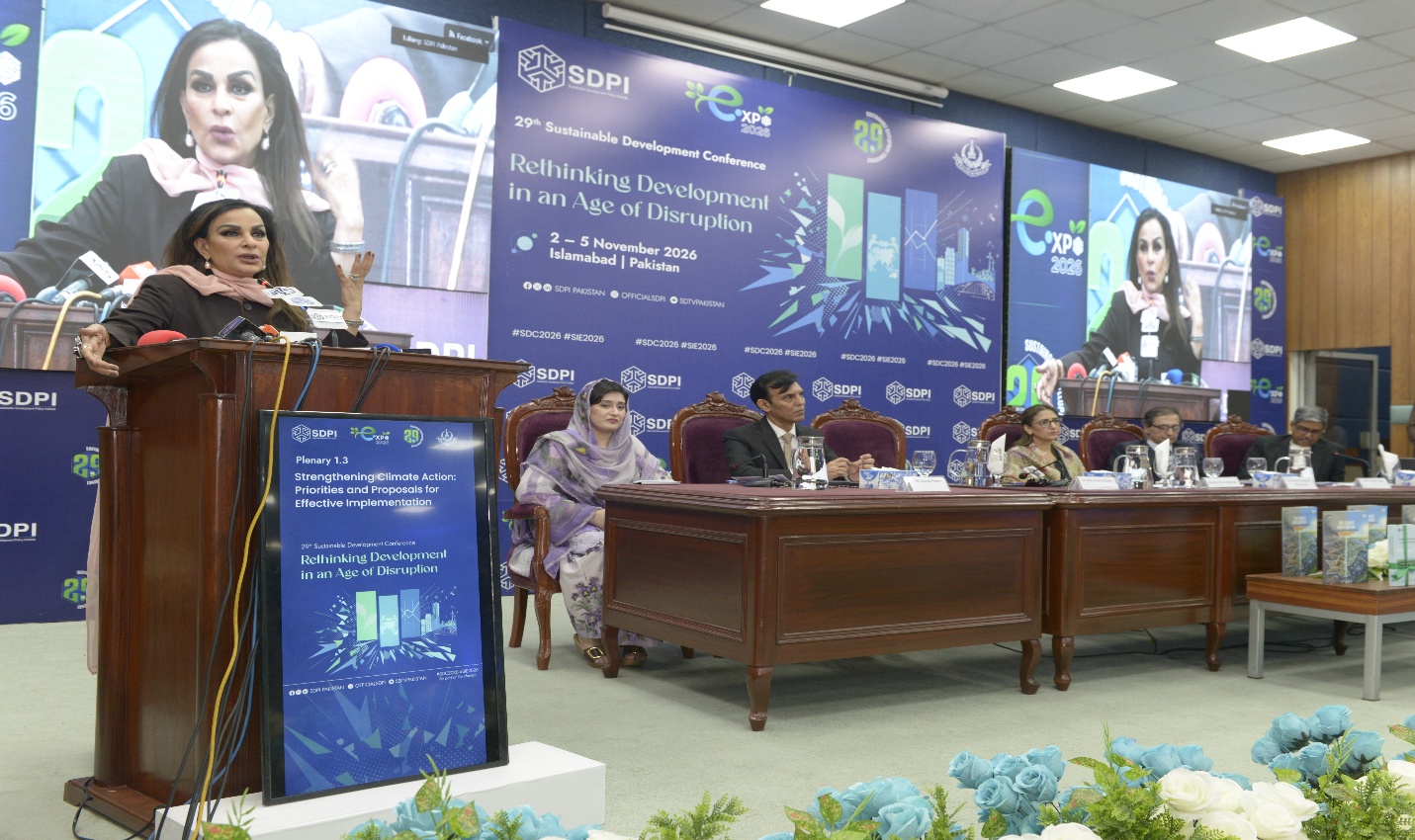
Strengthening Climate Action: Priorities and Proposals for Effective Implementation, Day 1, Plenary 1.3, 02 Nov
Climate action requires decentralization, empowerment of local authorities, say experts
Pakistan's Judiciary lead the world in defining climate law: Justice Jawad
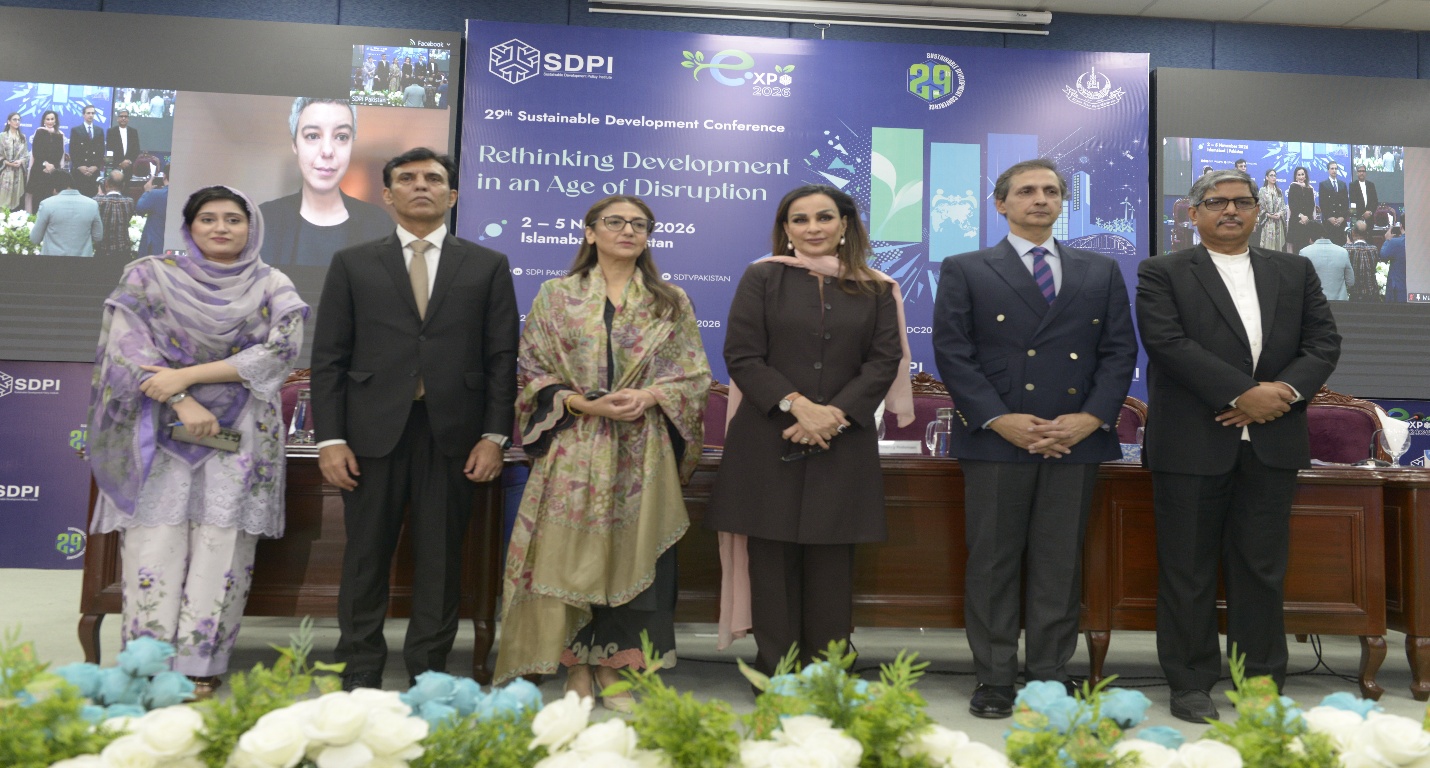
ISLAMABAD (02 November 2026): Chairperson of Senate Standing Committee on Climate Change, Senator Sherry Rehman, while drawing a parallel between two eras of ecological neglect: the historical period when industries consumed massive amounts of fossil fuels and emitted carbon while the world looked away, and the present day, where Artificial Intelligence and data centers are consuming immense quantities of water, has said the world is still not paying enough attention to all the critical issues.
She was speaking at a plenary, titled: ‘Strengthening Climate Action: Priorities and Proposals for Effective Implementation’, organized on the inaugural of 4-day Sustainable Development Conference held by the Sustainable Development Policy Institute at the Allama Iqbal Open University here on Monday. The overarching theme of this year’s conference is ‘Rethinking Development in an Age of Disruption’.
“We are in an Axial Age. The advent of El Niño means that we are in a century of water scarcity,” the Senator said, noting that Pakistan is stuck in recovery mode. “Every summer, there is a disaster and even if there is a gap, the country remains in recovery mode,” she said and added that AI, climate impact, and water scarcity are all connected and it is the high time that the world pays attention, because “What happens in Pakistan won’t stay in Pakistan; be it heat waves, floods, or cost of living crisis and protests.”
Justice Jawad Hassan of the Lahore High Court (LHC) while highlighting a number of initiatives by the Pakistan’s judiciary towards climate action, noted that Pakistan has led the world not only in turning soft laws and climate warnings into hard laws enshrined in the constitution, but also become the country to have complied with all climate related international provisions in the ESG framework.
“Judgments issued by the courts of Pakistan have been commended all across the world, and have also been included in a Cambridge University’s book on Islam and the environmental law,” Justice Hassan said, adding that Pakistan has been developing environmental and conservation strategies since the seventies.
Minister of State for Climate Change and Environmental Coordination, Dr Shezra Mansab Ali Khan Kharal, said that climate change and disaster know no boundaries, “Nepal’s disaster is a recent example, and our mountains are very similar.” She said that these changes are also affecting our economies, and “the Government of Pakistan recognizes this urgency”. She listed multiple policies and plans that the government has issued to tackle environmental challenges, including the National Adaptation Plan, National Drought Plan, National Climate Finance Strategy, and the Climate Prosperity Plan. “An Investor Book has also been developed to streamline projects and investment,” she added.
Sustainable Development Policy Institute (SDPI) Executive Director Dr. Abid Suleri highlighted the challenges in climate adaption approaches, potential solutions and the challenges in the implementation of those solutions. “Climate action is as good as it is implemented, and not a lot of it actually does. As they say Islamabad is a graveyard of very good policies,” he said, adding that in the upcoming UN General Assembly there will be a discussion on the post SDG-era roadmap, which is why Pakistan needs actionable and potent “macro, meso and micro level implementation of climate action.”
Sharing the findings of UNEP Report on Global Emissions Gap, he noted the shocking revelation that the global temperature will increase by 2.8 degrees by the end of this century, far ahead of the 1.5 degrees predicted earlier. Dr. Suleri also noted that 99% of the climate action falls outside the ambit of the Ministry of Climate Change, which necessitates integration between multiple ministries.
Tracy Mamoun from Southern Voice said climate action should not be in silos. Multiple countries are facing similar issues and require a coordinated approach to their resolution,” she added. She also raised a few questions regarding the current level and approach of climate action across the world. She said, “impact of climate change is often localized, so there is a question of decision-making authority, which often does not lie with the local governments.”
Mamoun also spoke on broader projects that can impact the climate and environmental realities on a local level but local parties often do not have a say in what projects should be taken on board by the central governments. Thirdly, she linked the same issues to the financing for climate issues, saying that decentralized financial mechanisms are needed. Finally, she raised the point of integrating climate action into development priorities, instead of dealing with projects as additional administrative responsibilities.
Mozaharul Alam, Climate Change Programme Regional Coordinator at the UN Environment Programme said that while the UNEP report has warned of the higher temperature hike globally, an even more significant point to consider is the uneven rise. “Asia Pacific experiences global warming at twice the rate as the rest of the world,” he noted, adding, “the rise in temperature will be different across different countries and across different sectors, such as water and food, and even health.” He said that “context specificity” is extremely important while considering the impact of climate change on our current development and infrastructure, as well as on future development and infrastructure.
Alam also spoke on private climate financing and said that while the private sector offers an important source of financing, “we need to be mindful of their capacity and limitations,” since private sector financing is almost always focused on resolving private and specific issues, such as clearing one supply-chain, instead of broader goals that can only be catered to through public climate financing.