Towards Operationalising Country Platforms for Climate Finance in Pakistan: Readiness & Gaps, Day 3, B4. 04 Nov
Pakistan faces $348bn climate finance gap by 2030: PM’s Coordinator
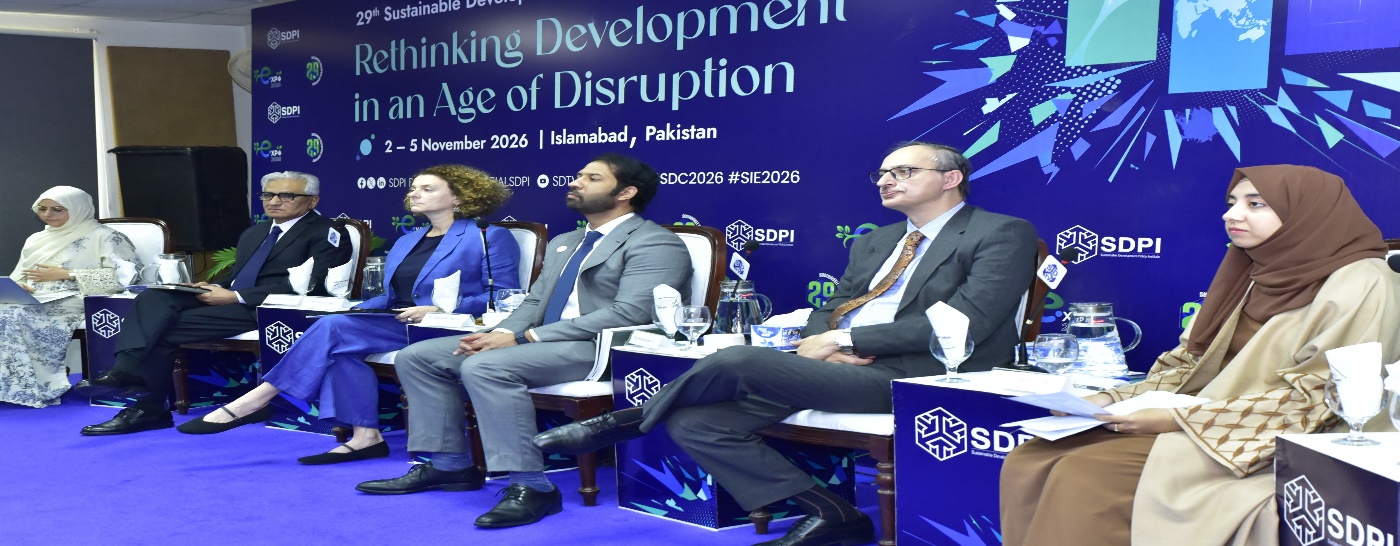
ISLAMABAD (04 November 2026): Pakistan faces an estimated climate finance gap of $348 billion by 2030, requiring concessional financing, private investment and equitable access to global carbon markets to support its transition towards a climate-resilient economy, said Coordinator to the Prime Minister on Commerce and Industries Rana Ihsaan Afzal Khan.
He was speaking at a session, titled: 'Operationalizing country platforms for climate finance in Pakistan: Readiness and Gap', organized at the 29th Sustainable Development conference by Sustainable Development Policy Institute here on Wednesday.
The coordinator said climate justice meant financing the transition rather than merely demanding it, urging the international community to move beyond commercial debt and fulfil its historical responsibilities through loss and damage funds and multilateral concessional financing.
He said Pakistan was moving from policy formulation to implementation through its Climate Prosperity Plan, Pakistan Green Taxonomy and a multi-sectoral country platform aimed at aligning international climate finance with national priorities.
Highlighting the renewable energy transition, Rana Ihsaan said Pakistan imported more solar capacity than any other country in 2024, while distributed solar supplied over a quarter of national electricity in 2025. The country also imported around 4.5 gigawatts of battery storage equipment during the last six months, he said, adding that the government was preparing a policy to encourage local battery manufacturing and establish Pakistan as a regional manufacturing hub.
The recently approved Auto Policy 2026-31 and Electric Vehicle Policy aim to achieve 30 percent EV penetration by 2030, with projected economic savings exceeding $15 billion. He said the Pakistan Accelerated Vehicle Electrification (PAVE) programme was providing subsidies for electric two-wheelers and three-wheelers, while Pakistan had secured 15th position globally in the 2026 Climate Change Performance Index and submitted its NDC 3.0.
He said Pakistan targeted sustainable, export-driven GDP growth of 6 per cent, with renewable energy and green agriculture contributing towards the ambition of expanding the economy to $1 trillion by 2035. Rana Ihsaan stressed that implementation required coordination among federal ministries, provincial governments and specialized agencies.
He said Sindh has finalized 13 carbon market projects with the potential to reduce emissions by over 330 million tons, alongside a pipeline of climate projects worth nearly $62 million. He further said international climate funds and institutional investors had capital but lacked bankable projects, underscoring the need for project preparation facilities to convert national priorities into commercially viable investment opportunities.
Rana Ihsan added that the Ministry of Commerce was working to establish a national compliance entity to help exporters meet emerging international environmental requirements, including the European Union's Carbon Border Adjustment Mechanism (CBAM).
Hamza Ali Haroon, Regional Director for South and West Asia at CVF-V20, said Pakistan's Climate Prosperity Plan had been expanded from 69 projects worth $4.5 billion to 100 projects costing $8.5 billion. He said the revised second version of the plan had been submitted to the Ministry of Finance, while the broader initiative envisaged mobilizing $1.6 trillion by 2050. He said the plan, launched in April 2026 in collaboration with the Finance Ministry, was now moving towards operationalization through a nationally owned, outcome-driven country platform.
Six operational models were developed after consultations with ministries and stakeholders. He said institutional structure and membership arrangements could be negotiated, but national ownership, implementation capacity and investment expertise were non-negotiable.
Adviser to the Finance Minister Adnan Pasha said the Finance Division was committed to leading the institutional architecture for climate finance mobilization, stressing that the initiative must move beyond dialogue towards a concrete implementation plan. Describing climate change and population growth as existential risks, he said the Finance Division would facilitate projects undertaken by federal ministries and provincial governments.
Under the proposed mechanism, provincial projects would be developed and routed through respective Planning and Development Departments before prioritisation by the Ministry of Climate Change and Environmental Coordination. The Finance Division would design the financial architecture, while the Economic Affairs Division and External Finance Wing would facilitate engagement with development partners and structure financing transactions. He said nationally owned priorities and provincial differences in climate adaptation requirements must guide project selection and financing.
Dr Muhammad Rafiq of the Pakistan Climate Change Authority (PCCA) said the Authority was working to establish a country platform to integrate scattered federal and provincial climate initiatives and improve coordination, governance and climate finance planning.
He said the PCCA, operationalized under the Pakistan Climate Change Act 2017, had a nationwide mandate, with six provincial and five federal members possessing expertise in adaptation, mitigation and climate finance. He said climate-related initiatives were currently being implemented by different ministries and provincial institutions in silos, resulting in gaps in data, governance, planning and budgeting.
The proposed platform would integrate existing frameworks, including the Finance Ministry's Sustainable Finance Framework, the Planning Ministry's Blended Finance Framework and the Climate Change Ministry's National Climate Finance Strategy.
Dr Rafiq clarified that the PCCA would not replace federal ministries or provincial governments but would work with them to integrate climate action. He said the proposal had been submitted to the Green Climate Fund (GCF), with a decision expected next week.