Partner: AHD, UNEP
Duration: 2010-11
Locale: Islamabad, Rawalpindi and Hyderabad
Team Members: Dr. Mahmood A. Khwaja
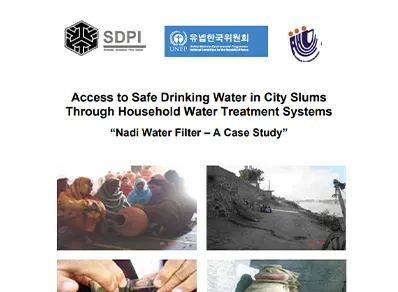
Introduction: Unclean water contaminated chemically or microbiologically is a health hazard. Many deaths (mostly of children under the ages of five) are caused annually by water-borne diseases such as Cholera, Typhoid fever, Diarrhoea, Dysentery, Hepatitis A and other diarrhoeal diseases According to WHO reports 80% of all infections are traceable to poor quality of drinking water. The estimated cost to Pakistan's economy due to diarrhoeal disease is estimated at Rs.55-80 billion/yr. Household-level interventions for water treatment must be given priority, as this will contribute to the safety component, which in turn is expected to significantly contribute to achieving the Millennium Development Goals and food security. Adequate accessible methods for household water treatment at point of use (POU) and safe storage (HWTS), combined with hygiene promotion could prevent the population suffering from (without access to safe drinking water) from illness and often resulting in death. The easy self-help Nadi Dinking Water Filter, a bio-filter type, is unique in its simple design, assembly and cost. The filter consists of baked clay Nadi & Mataka, sand & gravel of different mesh sizes and a rubber or plastic tube. The effectiveness of the Nadi filter unit is evident from the color, taste & transparency of the water filtered through it, as well as the laboratory reports of bacteriological examination of the filtered water samples. In an earlier completed project, conducted by the Association for Humanitarian Development (AHD) in collaboration with Sustainable Development Policy Institute (SDPI), over 1000 NWF units were installed and are operating in 20 villages of Taluka Jati area in District Thatta, Sindh, Pakistan. A noticeable decrease in diseases has been reported by Nadi water filter users (specially infants/children's) visits to doctors/hospital. The present work in the city slums is carried out by SDPI, in collaboration with AHD and with financial support from UNEP National Committee for the Republic of Korea (UNEP NATCOM ROC) and is an extension of the above referred earlier work Slums of Islamabad, Rawalpindi and Hyderabad cities are selected for the present work. These areas not only have problems of shortage of water but available water is also considered unsafe for drinking. On conducting the survey of the slums, it was established that most of the diseases in the area are water borne. The health and hygiene conditions in the slums are deplorable. Water borne diseases, like stomach worms and dysentery and skin diseases are rampant. Besides, introducing a simple technique like the Nadi water filter to clean water, another objective of the project was to also familiarize the population of the slums with the hazards of contaminated water use. Several awareness raising and training workshops were held with female & male residents of each slums. Material for assembling Nadi water filters was also distributed during training workshop. Monitoring and evaluation of the effectiveness of the Nadi filters installed and their maintenance is in progress.
© 2026 SDPI. All Rights Reserved Designed and developed by NKMIS WEB Unit