Rethinking the Selection of the UN Secretary-General: Insights from the Global South
Duration of Project: 2025-26
Donors/Partners: 1 for 8 Billion and Southern Voice
Project Focal Person from SDPI: Dr Abid Qaiyum Suleri, Ms Sadia Satti & Ms Ayesha Naeem
Locale: Global South
Program/Project Rationale and Background
Since its launch in 2015, the 1 for 8 Billion campaign has worked to move discussions on the selection of the UN Secretary-General beyond diplomatic circles in New York and into wider public debate across countries and regions. Strengthening Global South participation has remained central to that effort.
In 2025, Southern Voice partnered with the Sustainable Development Policy Institute, along with four other organisations from across the Global South:
1: Centro de Implementación de Políticas Públicas para la Equidad y el Crecimiento (CIPPEC, Argentina)
2: Centre for Policy Dialogue (CPD, Bangladesh)
3: Economic and Social Research Foundation (ESRF, Tanzania)
4: Solidar Tunisie (Tunisia)
Together, these organisations produced original research in the form of 5 Policy Briefs and 1 Synthesis Report, examining the structural conditions shaping the selection of the next UN Secretary-General and their implications for legitimacy, representation, effectiveness, and global governance.
Across the policy briefs, several common concerns emerge. The current process continues to be shaped by opacity, unequal participation, and political negotiations concentrated among a limited number of actors. The briefs also show how barriers affecting women and candidates outside traditional centres of power continue to narrow the pool of politically viable candidates. The research further highlights how representation shapes institutional credibility and effectiveness. The recommendations call for:
- Stronger transparency in the selection process
- Broader participation by Member States and civil society
- Greater political support for women candidates
- Reforms capable of strengthening the legitimacy and independence of future UN leadership
Download the Synthesis Report: Rethinking the Selection of the UN Secretary-General: Insights from the Global South
Download the Policy Briefs
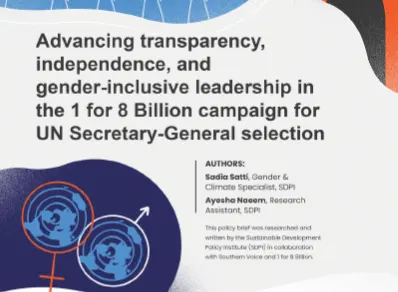
- Advancing Transparency, Independence, and Gender-Inclusive Leadership in the 1 for 8 Billion Campaign for the United Nations Secretary-General Selection - Authors: Sadia Satti and Ayesha Naeem: Based on evidence and Pakistan’s experience, this brief analyses how opaque power dynamics and networks dominated by major powers continue to restrict women’s access to UN leadership. It calls for reforms that strengthen transparency, reduce reliance on informal negotiations, and expand the role of non-permanent members of the Security Council in the selection process.
- The Next United Nations Secretary-General from a Global South Perspective: Legitimacy, Effectiveness, and a Historic Opportunity for Gender Equity -Authors: Gala Díaz Langou, Abril García Mur, and Bruno Muñoz (CIPPEC, Argentina): This brief argues that the selection process itself shapes the legitimacy, independence, and authority of the future Secretary-General. From a Latin American perspective, it calls for a more transparent and participatory process capable of addressing structural inequalities, particularly the historic exclusion of women, while aligning UN leadership with Global South priorities such as financing, climate action, food security, and inequality reduction.
- Rethinking UN Leadership in a Fragmented World: A Bangladesh-Centred Perspective - Authors: Fahmida Khatun, Afrin Mahbub, and Ayesha Suhaima Rab (CPD, Bangladesh): Drawing on Bangladesh’s experience, this brief examines the kind of leadership the UN requires in a context of interconnected crises and growing institutional strain. It shows that the underrepresentation of women remains structural and begins at the nomination stage, limiting the pool of viable candidates. The brief also highlights the importance of coordination capacity, strategic vision, and protecting vulnerable populations during periods of global instability.
- Eighty Years Without a Woman Secretary-General: Gender, Geography, and UN Leadership Legitimacy - Authors: Linda Mhando, Richard Ngilangwa, and Vivian Kazi (ESRF, Tanzania): This brief examines how the absence of a woman Secretary-General reflects broader imbalances in global governance. From a Tanzanian perspective, it argues that gender representation and geographic balance are essential to the credibility and effectiveness of the UN, particularly at a time when many of the organisation’s most pressing crises are concentrated in the Global South while decision-making power remains concentrated among a small number of actors.
- From Electoral Representation to Global Executive Leadership: Lessons from Tunisia for Advocacy in Support of Electing a Woman as Secretary-General of the United Nations - Author: Khaled Mejri (Solidar Tunisie, Tunisia): Using Tunisia’s experience as a starting point, this brief explores how institutional rules, political dynamics, social norms, and resource inequalities shape women’s access to leadership. It highlights how seemingly neutral processes can continue reproducing exclusion in the absence of corrective mechanisms and underscores the importance of coalition-building, political coordination, and structural reforms to support women candidates in the selection of the next Secretary-General.
© 2026 SDPI. All Rights Reserved Designed and developed by NKMIS WEB Unit